In this article
What AdBlue is and why your diesel needs it
AdBlue is neither a fuel nor a diesel additive. It is a clear fluid that never enters the engine. It is injected into the exhaust system ahead of the selective catalytic reduction catalyst, SCR for short. There it produces a substance that breaks down harmful nitrogen oxides into nitrogen and water vapour, which are ordinary components of air.
The name AdBlue is a registered trademark. Technically, it is AUS 32 solution, whose quality is defined by the international standard ISO 22241. According to the standard, it contains 32.5% technically pure urea dissolved in clean, demineralised water. The standard allows only a narrow range of 31.8 to 33.2%. That is one reason why the car’s control unit expects an exact composition and will not accept any other fluid.
Why all this? In Regulation (EC) No 715/2007, the European Union tightened emission limits. For diesel passenger cars, the Euro 5 standard allowed at most 180 mg of nitrogen oxides per kilometre, while Euro 6 allows only 80 mg/km. Most manufacturers bridge this gap with an SCR system using AdBlue. If you are not sure whether your car has one, check the owner’s manual or look for a second filler neck with a blue cap. When choosing a car, it also pays to know the other differences between fuels, which we cover in the article Used car: diesel or petrol.
How much AdBlue a car uses and when to top it up
AdBlue consumption is far lower than diesel consumption, but it depends on the model, engine load and driving style. Škoda states a consumption of 1.5 to 2.8 litres per 1,000 km for its cars and a tank capacity of 11 to 19 litres. Mercedes-Benz writes in its owner’s manuals that average AdBlue consumption amounts to 1 to 5% of fuel consumption, and for some models it lists a tank of around 24 to 25 litres.
To give you an idea: at a consumption of 1.5 to 2.8 litres per 1,000 km, a full 11-litre tank lasts roughly 3,900 to 7,300 km. A larger tank lasts longer, while hard driving, towing a trailer or frequent trips under full load increase consumption. Many cars show the AdBlue range directly in the on-board computer, so you can check it at any time.
You do not have to wait for a service inspection to top up. Manufacturers recommend adding AdBlue when the car warns you, or earlier before a long journey. If you drive a lot, it is worth keeping a small container in the boot so that the warning does not catch you far from a filling station.
When buying a used diesel, it is also worth checking the condition of the AdBlue system. Ask the seller whether AdBlue or emission system messages have appeared on the dashboard, and have a workshop read the fault memory. If the seller cannot tell you when AdBlue was last topped up, that is not a reason to reject the car, but it is a reason for a more thorough inspection.
Dashboard warnings and what happens when it runs out
The rules for warnings are not up to individual brands. They are set by Commission Regulation (EU) 2017/1151 in Annex XVI, which applies to the type approval of Euro 6 cars throughout the Union. The car must visually alert the driver when the AdBlue level is falling, when dosing is interrupted or when the quality of the fluid does not meet the manufacturer’s requirements.
The regulation prescribes how the warning escalates:
- The first warning must appear no later than when at least 2,400 km of range remain. The manufacturer may also choose another threshold derived from the range on a full fuel tank or from 10% of the AdBlue tank volume, whichever occurs first.
- The warning intensifies as the tank approaches empty, until it is continuous. It must be easy to understand, for example a low AdBlue level message, and it cannot be switched off until you top up the fluid.
- A system that forces the driver to act must ensure that the car does not run with an empty AdBlue tank. In practice, this means a countdown, after which you will not be able to restart the engine.
So be careful: the car will not cut out in the middle of a motorway drive, but once you switch off the engine after the countdown has ended, you will not start it again. Volkswagen and Škoda put it simply: without AdBlue, the engine will not start. It is therefore not worth waiting until the last minute, especially in winter or before a trip abroad.
When the warning appears for the first time, treat it as a reminder, not a fault. Check the remaining AdBlue range in the on-board computer and plan to top up within the next few days. If the warning does not disappear immediately after topping up, drive the car for a while. Some systems need a short time to register the new level. If it still does not go out, the car belongs in a workshop.
Where to buy AdBlue and how to top it up safely
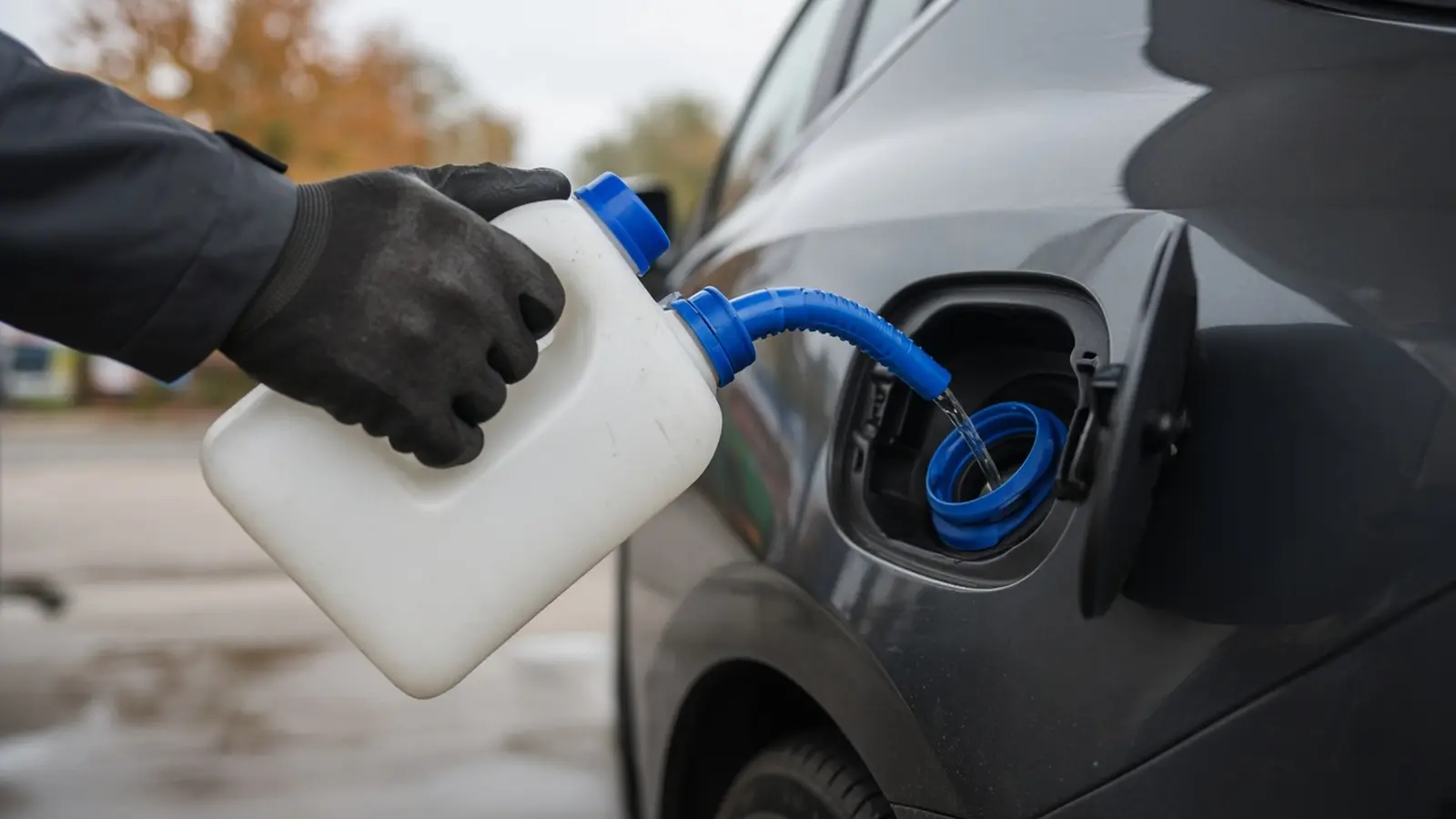
AdBlue is sold all over Europe. At many filling stations you will find a dedicated pump, as well as bottles and canisters at filling stations, in car workshops and in car accessory shops. You can top it up yourself or leave it to a workshop.
Depending on the model, the filler neck can be in different places. Škoda states that it may be next to the diesel filler neck, in the boot or in the spare wheel well. When topping up, follow a few rules:
- Only buy fluid marked with the ISO 22241 standard in undamaged packaging.
- Use a container or nozzle that fits the filler neck well and does not drip.
- Top up in a well-ventilated place. Ammonia vapours may escape when the tank is open, and the fluid irritates the skin, eyes and respiratory tract.
- Wipe up spilled AdBlue as soon as possible with a damp cloth and plenty of cold water. Dried fluid forms white crystals on the paintwork, which Škoda recommends removing with warm water and a sponge.
There is no need to panic in winter. AdBlue freezes at approximately −11 °C, but cars come with heated tanks and lines from the factory, so the system works even in frost. Mercedes-Benz points out that if you top up at temperatures below −11 °C, the level indicator may show an incorrect reading for a while. About 20 minutes of driving and a short stop will help.
Risks of the wrong fluid and refuelling mistakes
The most expensive AdBlue mistakes happen by accident or in an attempt to save money. The control unit expects a solution meeting ISO 22241. If the sensor detects that the fluid in the tank does not meet the manufacturer’s requirements, Regulation 2017/1151 requires a warning, for example an incorrect fluid message. If you do not fix the problem within 50 km, the same mechanism kicks in as with an empty tank, i.e. a countdown leading to a start block.
So never pour water, antifreeze or any other fluid into the AdBlue tank, and do not mix your own solution. Škoda explicitly warns against any other fluids, including antifreeze agents.
The opposite mistake is even more serious. If you were to pour AdBlue into the diesel tank, do not start the engine and contact a workshop. This is also what Škoda recommends. The fluid does not belong in the fuel system, and removing it is a job for professionals, not for improvising in a car park.
If the dashboard warning appears even after you have topped up with the correct fluid, do not wait. It may be a fault in the sensor, pump or heater, which only a workshop with diagnostic equipment can verify. Dealing with it in time is cheaper than towing a car that will no longer start.
Key takeaways
- AdBlue is a 32.5% solution of urea in demineralised water as defined by ISO 22241. It is injected into the exhaust and, together with the SCR catalyst, breaks down nitrogen oxides.
- Regulation (EU) 2017/1151 requires the car to warn the driver no later than when at least 2,400 km of range remain before the AdBlue tank runs empty.
- With an empty AdBlue tank, the car will not restart once the countdown has ended.
- Škoda states a consumption of 1.5 to 2.8 litres per 1,000 km; Mercedes-Benz states 1 to 5% of fuel consumption.
- Never pour anything else into the AdBlue tank. If you accidentally put AdBlue into the diesel tank, do not start the engine and call a workshop.
FAQ
- Can I keep driving when the AdBlue warning comes on?
- Yes. Under EU rules, the first warning appears with a large margin, usually at least 2,400 km before the tank runs empty. You should, however, top up as soon as possible, because once the countdown has ended the car will not restart.
- Can I top up AdBlue myself?
- Yes. Buy fluid marked ISO 22241, top up in a ventilated place and wipe up any spills immediately with a damp cloth and cold water.
- What should I do if I accidentally pour AdBlue into the diesel tank?
- Do not start the engine and contact a workshop. The fluid does not belong in the fuel system, and removing it is a job for professionals.
- Does AdBlue freeze in winter?
- It freezes at approximately −11 °C, but cars have heated tanks and lines, so the system works even in frost. When topping up in severe frost, the level indicator may show an incorrect reading for a while.
Comments
No comments yet. Be the first.
Add a comment
Your comment appears once the editors approve it. We never publish your email.
Do you sell cars?
A website for your dealership with a stock list that syncs itself from the listing portals. In 8 languages, ready in minutes.
30 days free, no card