In this article
What Hyundai presented and when
The IONIQ range had so far offered only mid-size and large electric cars in Europe. Hyundai hinted at a change in September 2025 at the IAA Mobility motor show in Munich, where it presented the concept study Concept THREE. The carmaker described it as its first compact electric concept in the IONIQ range and linked it to its ambitions in the European B segment, which it calls a key market for compact electric cars.
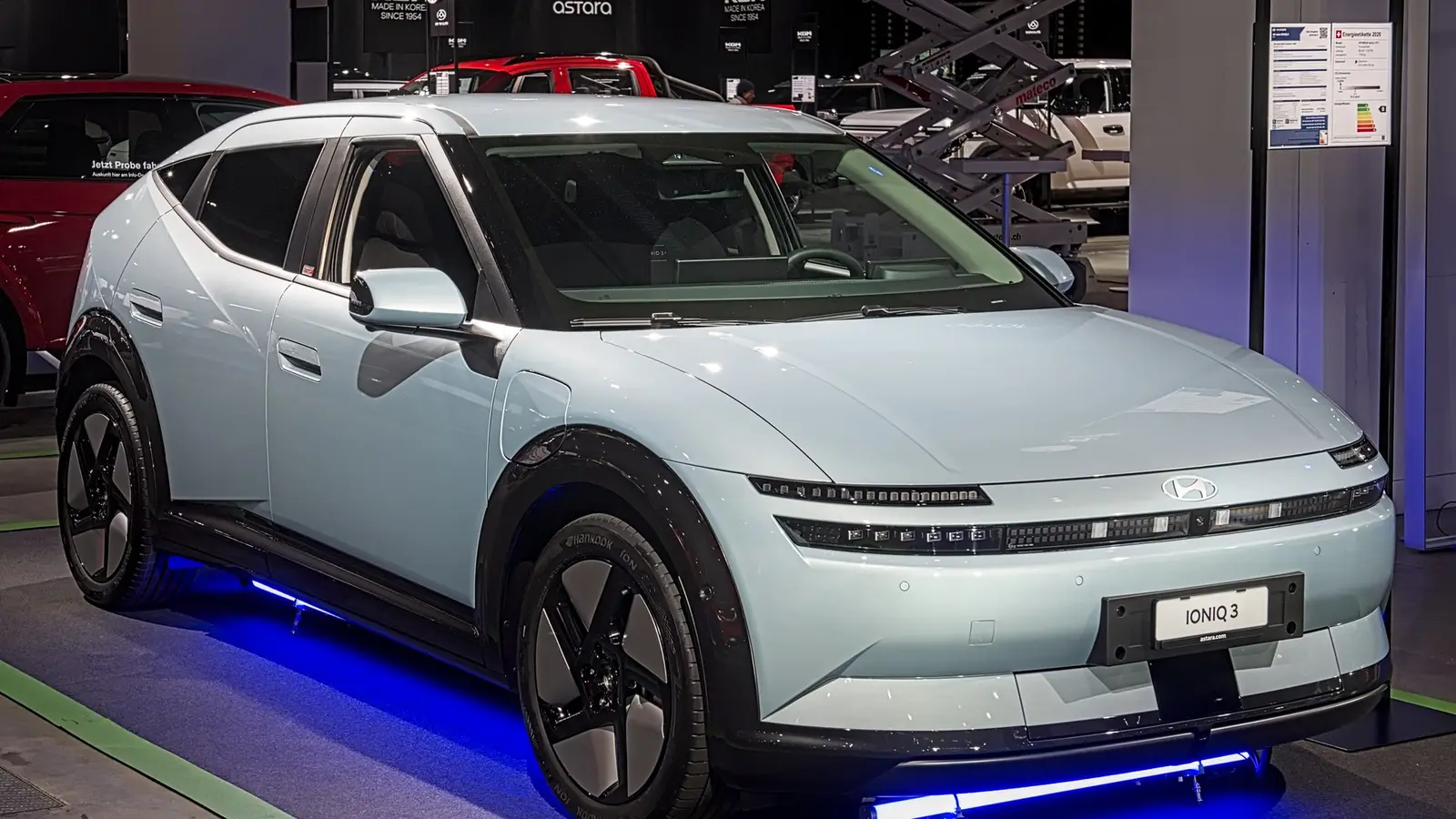
The production Hyundai IONIQ 3 followed on 20 April 2026. The maker calls it “Aero Hatch”: a compact hatchback with a roof that runs straight over both the front and rear seats and only then drops steeply to the spoiler. The car was designed in Europe and is built at Hyundai's Turkish plant in the city of İzmit.
Production there officially began on 14 August 2026. According to a Hyundai press release, the plant's conversion cost 250 million euros, and the Turkish minister of industry Mehmet Fatih Kacır said at the start of production that the plant will initially build 30,000 IONIQ 3 cars a year. According to the maker, sales were to begin in September 2026, depending on the market.
Dimensions, batteries and range
The IONIQ 3 measures 4,155 mm, the N Line version 4,170 mm. It is 1,800 mm wide, 1,505 mm tall (N Line 1,510 mm) and has a wheelbase of 2,680 mm. According to the maker, the luggage space totals 441 litres: 322 litres in the boot and 119 litres in the under-floor compartment that Hyundai calls the Megabox. The drag coefficient is 0.263 with 16-inch wheels; the N Line with 19-inch wheels has 0.288.
The drive is always front-wheel only and the line-up has two batteries. The figures in the table come from the current technical data of Hyundai Motor Europe.
| Parameter | Standard Range | Long Range |
|---|---|---|
| Battery | 42.2 kWh, LFP | 61 kWh, lithium-ion |
| Motor output | 107.8 kW (147 hp) | 99.5 kW (135 hp) |
| Torque | 250 Nm | 250 Nm |
| 0 – 100 km/h | 8.7 s | 9.5 s (N Line 9.6 s) |
| Top speed | 170 km/h | 170 km/h |
| WLTP range | 344 / 341 / 335 km (wheels 16 / 17 / 18") | 497 / 488 / 484 km (wheels 16 / 17 / 18") |
| WLTP consumption | 14.1 – 14.8 kWh/100 km | 13.7 – 14.1 kWh/100 km |
| DC 10 – 80% (350 kW station) | 29 min | 29 min |
| AC 10 – 100% (11 kW / 22 kW) | 4 h 06 min / 2 h 06 min | 5 h 36 min / 2 h 42 min |
Interestingly, the smaller battery comes with the more powerful motor. The N Line with the 61 kWh battery is quoted by the maker with a range of 456 km on 18-inch and 428 km on 19-inch wheels. The on-board charger is 11 kW as standard, 22 kW as an option. The V2L function powers appliances with up to 3.6 kW through a 230 V socket in the cabin or through the charging port.
Where it fits next to the IONIQ 5 and IONIQ 6
Within the IONIQ range, the IONIQ 3 sits below the larger models. It is 500 mm shorter than the crossover IONIQ 5, which after its facelift measures 4,655 mm and has a wheelbase of 3,000 mm. It falls 770 mm short of the liftback IONIQ 6 with a length of 4,925 mm and a wheelbase of 2,950 mm. Hyundai Motor Europe offers both larger models with 63 and 84 kWh batteries. According to the maker, the IONIQ 6 has a range of up to 680 km WLTP.
There is also a difference in the electrical system. The IONIQ 5 is built on an 800-volt system, whereas the IONIQ 3 has a 400-volt architecture. At a 350 kW station, according to the maker, the IONIQ 6 charges from 10 to 80% in 18 minutes, the IONIQ 3 in 29 minutes. Hyundai states that by 2027 it wants to have all its models electrified in Europe and that in 2025 electrified cars made up 24% of its European sales.
What the first drives showed
Journalists on the first drives add figures that are missing from the European technical data. The Czech auto.cz, which tested the car around Istanbul, and the British RAC both quote a maximum DC charging power of 119 kW for the smaller and 110 kW for the larger battery. Auto.cz praises the aerodynamics, but warns that the split rear window with a spoiler worsens the view to the rear.
In Europe, the cabin debuts the system Pleos Connect built on Android Automotive OS, with a 12.9- or 14.6-inch screen depending on the trim. Among the assistants, Hyundai names Highway Driving Assist 2, the Remote Smart Parking Assist remote parking and seven airbags as standard.
What remains open for now
- Safety: according to the RAC, as of 19 November 2026 the IONIQ 3 does not yet have a Euro NCAP rating.
- The figures changed: the April press release quoted a range of 344 and 496 km, a speed of 170 km/h and acceleration of 9.0 and 9.6 s. The first technical sheet spoke of more than 335 and 490 km and of 165 km/h. Hyundai wrote at the time that the figures were not final and were awaiting homologation. Today's European website quotes 497 km and 8.7 s.
- Platform name: the press release speaks of the E-GMP platform, the model's European website of the K3 platform. Both consistently quote a 400-volt architecture.
- Prices and delivery dates differ by country, so we do not give them here. Before ordering, check the price list and the homologated data in your country.
Key takeaways
- Hyundai presented the IONIQ 3 on 20 April 2026 as a compact electric hatchback designed for Europe.
- With the 61 kWh battery the maker quotes a range of up to 497 km WLTP, with the 42.2 kWh battery up to 344 km.
- At a 350 kW station, both versions charge from 10 to 80% in 29 minutes, according to the maker.
- The car measures 4,155 mm, is 500 mm shorter than the IONIQ 5 and has a 400-volt architecture.
- It does not yet have a Euro NCAP rating, and the April figures differ slightly from today's technical data.
FAQ
- What range does the Hyundai IONIQ 3 have?
- According to the technical data of Hyundai Motor Europe, the version with the 42.2 kWh battery has a range of up to 344 km WLTP and the version with the 61 kWh battery up to 497 km; both figures apply to 16-inch wheels. Larger wheels shorten the range; the N Line on 19-inch wheels is quoted at 428 km.
- How fast does the IONIQ 3 charge?
- At a 350 kW fast charger it charges from 10 to 80% in 29 minutes, according to the maker. At home or at a public AC station, charging from 10 to 100% takes 4 h 06 min or 5 h 36 min at 11 kW, and 2 h 06 min or 2 h 42 min with the optional 22 kW charger.
- Where is the IONIQ 3 built?
- At the Hyundai Motor Türkiye plant in the Turkish city of İzmit. Production began there on 14 August 2026, and the IONIQ 3 is the first electric car from this plant.
- Does the IONIQ 3 have a Euro NCAP rating?
- Not yet. The British RAC states that, as of 19 November 2026, the car has not yet been tested by Euro NCAP. The maker quotes seven airbags as standard and Hyundai SmartSense assistance systems.
Comments
No comments yet. Be the first.
Add a comment
Your comment appears once the editors approve it. We never publish your email.
Do you sell cars?
A website for your dealership with a stock list that syncs itself from the listing portals. In 8 languages, ready in minutes.
30 days free, no card