In this article
Just five years ago, Chinese brands were almost invisible in European registration statistics. Today, BYD, MG, Omoda and Jaecoo are a common sight in car parks in many countries of the Union. Anyone considering a car from a brand they had not heard of a few years ago is right to ask: is this a short-term blip or a lasting change in the market? And what does it mean for servicing, the resale price and the duties that are so much in the news? We looked at public pan-European data.
What share Chinese brands have in the EU
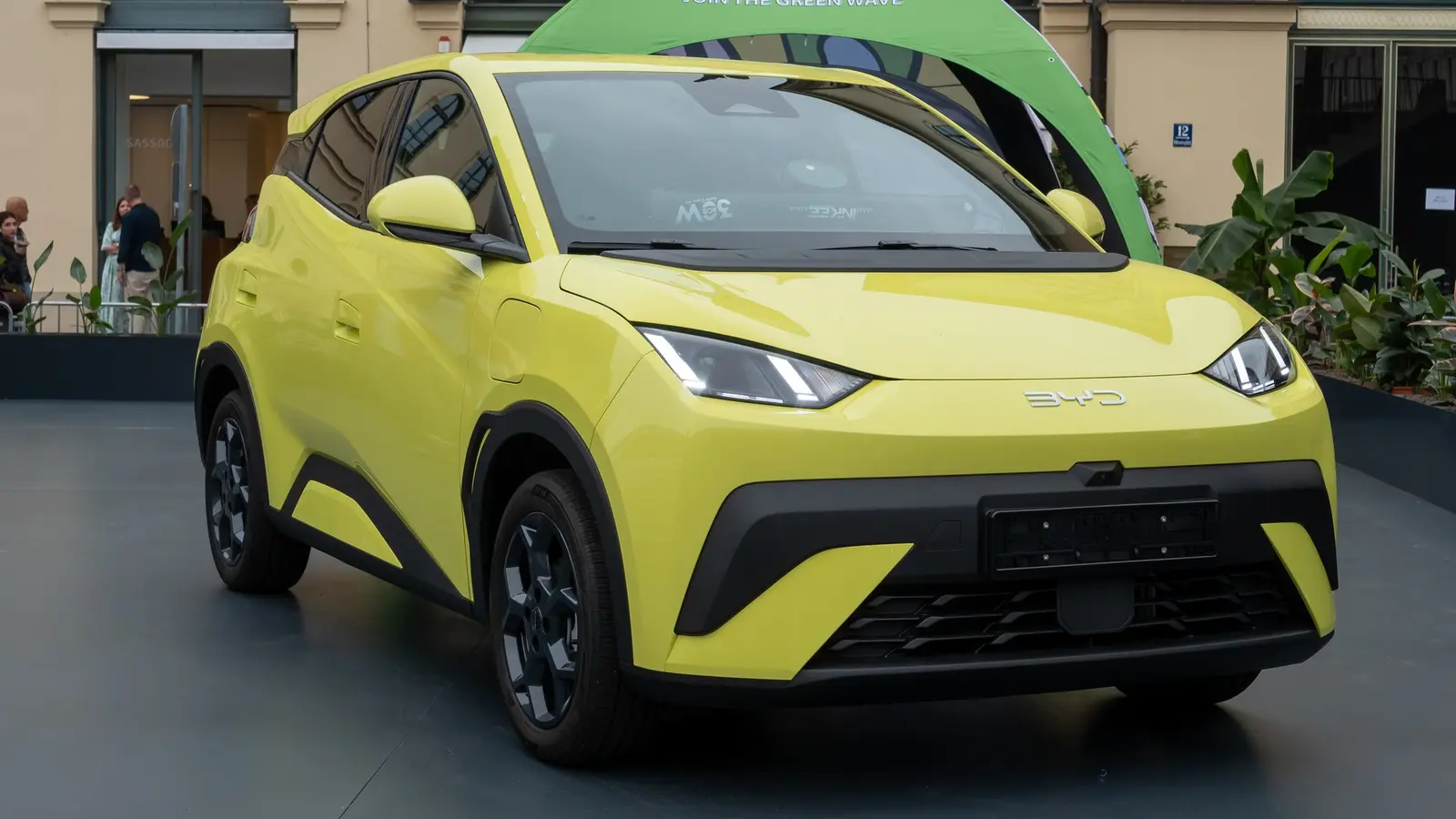
The most official source is the European Automobile Manufacturers’ Association, ACEA. In its table of registrations by manufacturer for January to September 2026, it lists four groups in the European Union with Chinese owners and Chinese brands: BYD with 206,002 cars and a share of 2.4%, SAIC Motor (MG and Maxus) with 186,650 cars and 2.2%, Chery (Chery, Omoda, Jaecoo and Jetour) with 137,003 cars and 1.6%, and Leapmotor with 72,760 cars and 0.9%. Together that is 602,415 of the 8,517,059 new cars registered in the EU in nine months, or about 7.1%.
Growth is steep. Year on year, BYD added 154.4%, Chery 246.5% and Leapmotor 393.6%. In September 2026 alone, these four groups together had about 8.5% of the EU market. ACEA also lists the Geely group with a share of 2.8%, but it also includes Volvo, Polestar and Smart, so we do not count it in the Chinese total. In Europe, Leapmotor is distributed by the joint venture Leapmotor International, which is controlled by Stellantis.
If you look at wider Europe, including the United Kingdom and the EFTA countries, the figures are even higher. The analytics firm Dataforce calculated that in the third quarter of 2026 Chinese brands had 12.7% of sales, while Japanese brands had 11.9%. It was the first time over a full quarter that Chinese brands overtook Japanese ones. For comparison: in 2021, according to Dataforce, they had only 0.6% of the market. JATO Dynamics states that just over 50,000 of their cars were registered in Europe in 2020, almost 700,000 in 2025, and for 2026 it forecasts more than 1.3 million cars.
Which brands are the strongest
The market is not fragmented among dozens of equal players. Dataforce counts 19 Chinese manufacturers in Europe, but five brands account for 83% of their sales. In the lead is BYD, which registered 217,000 cars in Europe by the end of July 2026 and reached a share of 2.4%. Close behind is MG, once a British brand and now part of the state-owned SAIC group. Chery with Omoda and Jaecoo had 1.7%, and the fastest-growing is Leapmotor, although its figures are driven largely by one market, Italy.
The powertrain mix is also interesting. According to Dataforce, hybrids already make up 53% of Chinese registrations in Europe, compared with 15% in 2021. In purely electric cars, Chinese brands have a European share of 12.6%. So manufacturers are not only offering electric cars, but also plug-in hybrids and conventional hybrids on a large scale. This is linked to the duties covered in the next chapter.
JATO also points to the breadth of the range: Chinese brands now offer more than 200 models in Europe. According to the same analysis, they have an average price advantage of about 9 to 10% over traditional competitors, although launch discounts have fallen by more than 40% in recent years and selling prices have risen.
EU countervailing duties on electric cars from China
On 29 October 2024, the European Commission concluded its anti-subsidy investigation and imposed countervailing duties for five years on new battery electric cars made in China. The rates depend on the manufacturer: BYD 17.0%, Geely 18.8%, SAIC 35.3%, other cooperating companies 20.7%, Tesla 7.8% and non-cooperating companies 35.3%. According to the Commission, these duties are added to the standard 10% import duty. For an electric car from SAIC, the total duty thus reaches 45.3%.
What the duties do not cover is important. Regulation (EU) 2024/2754 only covers cars powered exclusively by electric motors, including those with a combustion range extender. Plug-in hybrids and conventional hybrids are not included, which explains why Chinese brands in Europe have expanded their hybrid ranges so much. Nor do the duties apply to cars made outside China, regardless of the brand.
The system is evolving, however. In February 2026, the Commission accepted a price undertaking for the first time: Volkswagen (Anhui) may import the Cupra Tavascan without the countervailing duty if it sells it at no less than an agreed minimum import price, limits volumes and invests in the EU. In a joint statement of 9 October 2026, the EU and China said they had reached an understanding on trade in hybrid vehicles and would continue proceedings on price undertakings by individual companies. For buyers, this means that the price of a given model can depend on where it is made and whether a duty applies to it.
Servicing and residual value
With a new brand, the list price is not the only thing that matters. JATO Dynamics counts trust in the brand and the density of the dealer and service network among the main obstacles for Chinese manufacturers: European customers want maintenance and repairs within easy reach, and such a network cannot be built overnight. Before buying, therefore, check where the nearest authorised workshop is, how long spare parts take to arrive and who represents the brand in your country.
European law helps you here. Regulation (EU) 2018/858, in Article 61, requires manufacturers to give independent workshops unrestricted and non-discriminatory access to diagnostic information, tools and repair and maintenance information. This applies to every car type-approved in the EU, including Chinese brands. Directive (EU) 2019/771, in turn, guarantees that the seller is liable for defects in goods that become apparent within two years of delivery, regardless of the manufacturer’s country of origin.
Residual value is the biggest unknown. In its analysis from August 2026, Indicata points out that the supply of used MG and BYD cars corresponds to roughly two months of sales, and almost three for Leapmotor. When supply persistently exceeds demand, used-car prices fall. Using British data, Indicata shows that the BYD Atto 3 holds its value reasonably well after 36 months, but does not reach the level of the Volkswagen ID.4, ID.5 or Hyundai Ioniq 5. According to Indicata, the used-car market values a brand’s whole ecosystem: trust, network strength, repairability and the number of people interested in a used car. If you plan to sell the car after three or four years, allow for a more cautious price estimate.
Differences between countries
The European average hides large differences. JATO states that Norway, the United Kingdom and Spain served as test markets and account for roughly three quarters of Chinese brands’ sales in Europe. The largest markets, such as Germany and France, remain less penetrated for now. For January to July 2026, Dataforce gives these shares:
| Region according to Dataforce | Share of Chinese brands, January–July 2026 |
|---|---|
| Spain, Portugal, Italy, Greece | 11.4% |
| Eastern Europe | 9.5% |
| Scandinavia | 7.3% |
| Central Europe | 5.1% |
| Germany | 4.1% (previous year 2.3%) |
| United Kingdom (outside the EU, no EU countervailing duties) | almost 16% |
| Europe total | 8.7% |
The differences have several causes: different state incentives for electric cars, different popularity of small cars, the density of the dealer network and the fact that European countervailing duties do not apply in the United Kingdom. This leads to a practical tip for you: if you are choosing a Chinese brand, find out how strongly it is represented in your own country. A strong local network means easier servicing and more interested buyers when you sell the car.
What it means for buyers
- This is not a marginal phenomenon. In the EU, four Chinese groups together have about 7.1% of the market, and in the third quarter of 2026 they overtook Japanese brands in Europe.
- The duty depends on the powertrain and the manufacturer. The countervailing duty only applies to electric cars from China, not to hybrids or cars made elsewhere.
- Check the servicing in advance. Ask about the nearest workshop and the availability of parts. Under EU law, independent workshops are entitled to technical information.
- Be cautious about residual value. The used-car market for Chinese cars is young and prices are still taking shape.
Chinese brands in Europe are maturing quickly. They are moving from test markets to the largest markets and adding equipment and warranties to their low prices. Whether they will last depends, according to analysts, above all on how quickly they gain trust and build a service network.
Key takeaways
- According to ACEA, BYD, SAIC Motor, Chery and Leapmotor together had 602,415 registrations in the EU from January to September 2026, or about 7.1% of the market.
- According to Dataforce, Chinese brands had 12.7% of sales in Europe in the third quarter of 2026 and, for the first time over a full quarter, overtook Japanese brands with 11.9%.
- EU countervailing duties on electric cars from China are 17.0% for BYD, 18.8% for Geely and 35.3% for SAIC, on top of the standard 10% duty; hybrids are not affected.
- According to Dataforce, hybrids already make up 53% of Chinese registrations in Europe, compared with 15% in 2021.
- The share varies widely between countries: 11.4% in Spain, Portugal, Italy and Greece, 4.1% in Germany.
FAQ
- What share do Chinese brands have of the new-car market in the EU?
- According to ACEA, the groups BYD, SAIC Motor (MG, Maxus), Chery (Chery, Omoda, Jaecoo, Jetour) and Leapmotor together had 602,415 of 8,517,059 registrations in the EU from January to September 2026, or about 7.1%. In wider Europe, including the United Kingdom, they had a share of 12.7% in the third quarter of 2026, according to Dataforce.
- Does the EU duty also apply to Chinese hybrids?
- No. The countervailing duties under Regulation (EU) 2024/2754 only cover new cars made in China that are powered exclusively by electric motors, including cars with a combustion range extender. Plug-in hybrids and conventional hybrids are not covered. The standard 10% import duty applies to electric cars from China in any case.
- Can I have a Chinese car repaired at an independent workshop?
- Yes. Regulation (EU) 2018/858 requires all manufacturers of cars type-approved in the EU to make diagnostic information, tools and repair and maintenance information available to independent workshops. Before buying, however, check the availability of spare parts and an authorised workshop near you.
- Do Chinese cars lose value faster?
- The used-car market for Chinese brands is still young. Indicata points out that the supply of used MG and BYD cars corresponds to about two months of sales, and almost three for Leapmotor, which pushes prices down. On British data, the BYD Atto 3 holds its value reasonably well after 36 months, but does not reach the level of established competitors.
Comments
No comments yet. Be the first.
Add a comment
Your comment appears once the editors approve it. We never publish your email.
Do you sell cars?
A website for your dealership with a stock list that syncs itself from the listing portals. In 8 languages, ready in minutes.
30 days free, no card