In this article
The sharp version of the electric Born
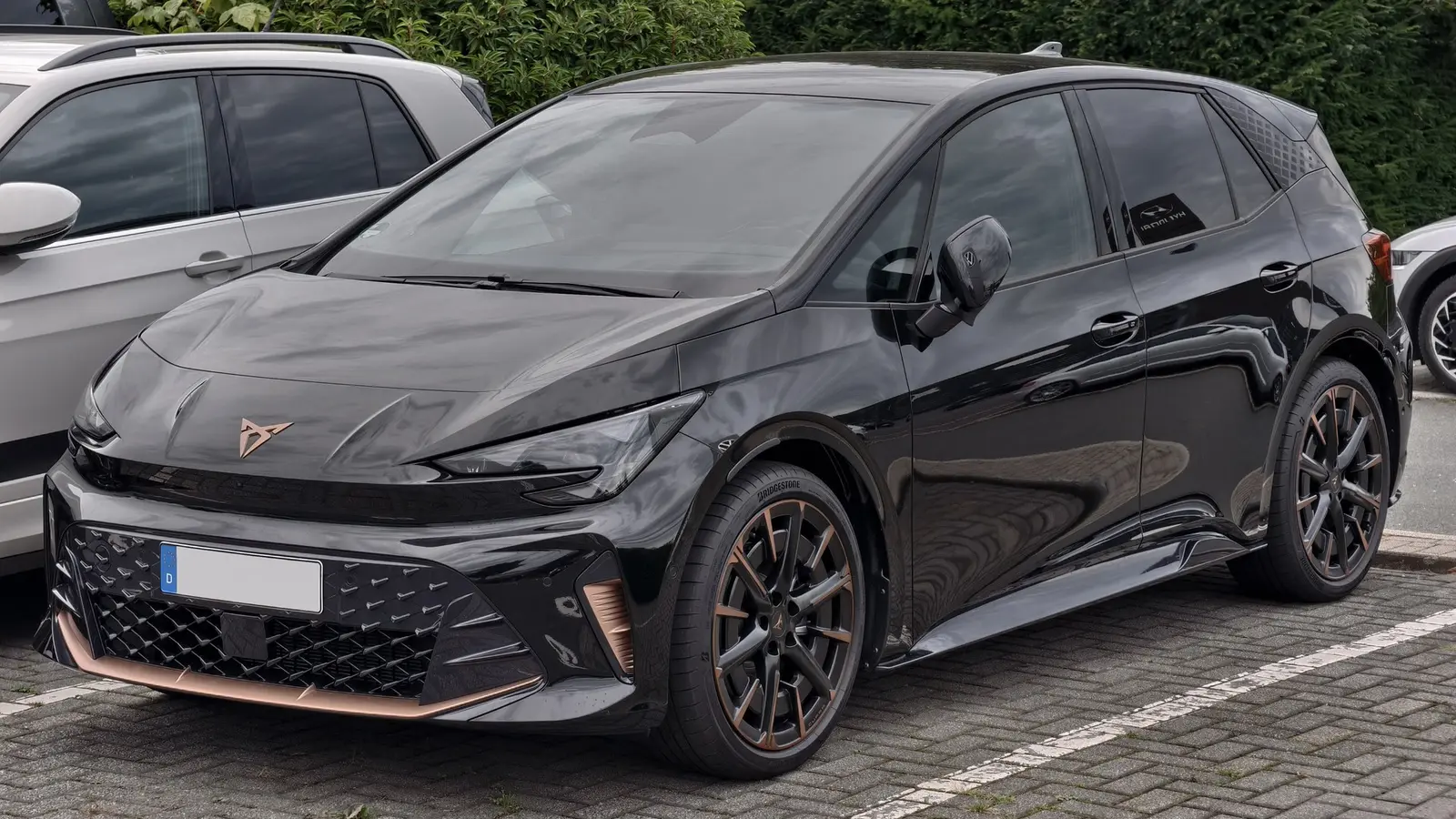
Cupra Born is the brand’s first purely electric model. The sporty VZ version is not new with the facelift: Cupra presented it back in 2024, when it gave the original Born a more powerful motor, a revised chassis and a higher top speed. In March 2026 the brand unveiled the updated Born, and the VZ has been part of its line-up from the start of sales as the most powerful version.
For prospective buyers, this means two questions at once. How does the VZ differ from the regular Born, and what has changed across the model with the update? The following figures come from the manufacturer; where the sources differ, we say so.
Power, battery and range according to the manufacturer
The updated Born offers three combinations of motor and battery. All of them drive the rear wheels only. The VZ has a motor with an output of 240 kW (326 hp) and a torque of 545 Nm. According to Cupra, it accelerates from 0 to 100 km/h in 5.6 s and from 0 to 50 km/h in 2.6 s, and its top speed is 200 km/h. According to a 2025 AUTO BILD test, the regular Born had a top speed of 160 km/h.
| Version | Power | Net battery | 0–100 km/h | WLTP range | DC rapid charging |
|---|---|---|---|---|---|
| Born 58 kWh | 140 kW (190 hp) | 58 kWh (LFP) | 8.0 s | 413–484 km | 105 kW, 10–80% in 26 min |
| Born 79 kWh | 170 kW (231 hp) | 79 kWh (NMC) | 7.0 s | 538–627 km | 183 kW, 10–80% in 29 min |
| Born VZ | 240 kW (326 hp) | 79 kWh (NMC) | 5.6 s | 552–631 km | 183 kW, 10–80% in 29 min |
So the VZ does not have a bigger battery than the more powerful regular version. Both use an NMC battery with a capacity of 79 kWh net (84 kWh gross) and charge the same way: with alternating current at 11 kW from 0 to 100% in 8 h 30 min. The VZ’s combined WLTP consumption is 14.1 to 16.2 kWh/100 km. The difference lies in power, in torque (545 Nm versus 350 Nm) and in weight: according to the catalogue, the VZ weighs 2,004 kg, while the Born with the same battery and 170 kW weighs 1,964 kg.
Chassis, steering and brakes
At the front there is a McPherson axle, at the rear a multi-link axle. The VZ comes as standard with the adaptive chassis DCC Sport, which the manufacturer offers on the other versions only as an optional extra. Cupra explains that for the VZ it matched the rear dampers and springs to the settings of the front damper valves, springs and anti-roll bars so that the body leans less. The electric power steering has a variable ratio and, on the VZ, more sharply tuned hardware and software.
In the catalogue, the front brakes measure 340 × 27 mm on both the regular Born and the VZ. For the VZ, the manufacturer cites a firmer brake-pedal feel. In its 2025 test of the original VZ, AUTO BILD wrote about revised rear brakes and wider 20-inch wheels with a rim width of 8 instead of 7.5 inches. In D mode, the driver selects regeneration in three levels using paddles behind the steering wheel. New with the facelift is one-pedal driving, which the Born did not previously offer.
What the facelift brings
From the outside, the new Born can be recognised by its triangular Matrix LED headlights at the front and the illuminated logo in the rear light signature. The front bumper is new. The 19 and 20-inch wheels have tyres 235 mm wide. Inside, there is a larger digital instrument panel with a 10.25-inch diagonal, while the central display measures 12.9 inches and runs a new system based on Android. Instead of touch surfaces, the steering wheel now has physical buttons, and the doors have new trim panels.
In addition, the VZ has standard Matrix LED headlights with a glare-free high-beam function, which cost extra on the other versions. It also has CUPBucket sports seats, which place the driver closer to the car’s centre of gravity, an E-Launch function for pulling away with full power, and an interior soundscape that responds to the accelerator, speed and driving mode. The dimensions remain the same for all versions: length 4,336 mm, width 1,809 mm, height 1,543 mm and a boot of 385 litres.
Availability in Europe and differences between sources
The new Born is built in Zwickau, Germany. According to Cupra, production began in the second quarter of 2026, and the market launch was scheduled for summer 2026. According to the manufacturer, the range of versions and equipment varies by country, so please check the specific configuration and price on the brand’s local website. AUTO BILD adds that an even less powerful version with a 50 kWh battery is due to follow later.
For some figures, the sources differ slightly. Cupra states a range of up to 631 km for the VZ, AUTO BILD 629 km. According to AUTO BILD, the original VZ had a range of 594 km and charged at up to 185 kW, whereas the updated model charges at 183 kW according to the manufacturer. Cupra states the torque as 545 Nm, AUTO ZEITUNG as 550 Nm after its first drive. In this article, we stick to the manufacturer’s figures.
Key takeaways
- The Born VZ has a motor with an output of 240 kW (326 hp) and 545 Nm, accelerates from 0 to 100 km/h in 5.6 s and reaches 200 km/h.
- The VZ uses the same 79 kWh net battery as the regular Born with 170 kW; the WLTP range is up to 631 km, and charging from 10 to 80% takes 29 minutes at 183 kW.
- The standard adaptive DCC Sport chassis, Matrix LED headlights and CUPBucket seats set the VZ apart from the other versions.
- The facelift brought new lights, a larger 10.25-inch digital instrument panel, physical buttons on the steering wheel and one-pedal driving.
- Production in Zwickau began in the second quarter of 2026, with the market launch in summer 2026; the range on offer varies by country.
FAQ
- Does the Cupra Born VZ have a bigger battery than the regular Born?
- No. According to Cupra, both the VZ and the Born with 170 kW have an NMC battery with a capacity of 79 kWh net. The VZ has a higher output of 240 kW, a torque of 545 Nm and a WLTP range of up to 631 km.
- What range does the Cupra Born VZ have after the facelift?
- Cupra states a combined WLTP range of 552 to 631 km depending on the equipment. AUTO BILD gives 629 km; before the facelift, the VZ had 594 km according to AUTO BILD.
- What is new on the Born after the facelift?
- Triangular Matrix LED headlights, an illuminated logo at the rear, a new front bumper, a 10.25-inch digital instrument panel, physical buttons on the steering wheel, an Android-based system and one-pedal driving.
Comments
No comments yet. Be the first.
Add a comment
Your comment appears once the editors approve it. We never publish your email.
Do you sell cars?
A website for your dealership with a stock list that syncs itself from the listing portals. In 8 languages, ready in minutes.
30 days free, no card


