In this article
When the clocks change and why you will notice it behind the wheel
The autumn clock change comes in the night from Saturday 24 October to Sunday 25 October 2026. At three o’clock summer time the clocks go back to two o’clock Central European Time, so the night is one hour longer. The date for 2026 is set by Slovak Government Regulation No. 522/2021 Coll. on summer time in the years 2022 to 2026, as summarised by the portal Právo pre ľudí.
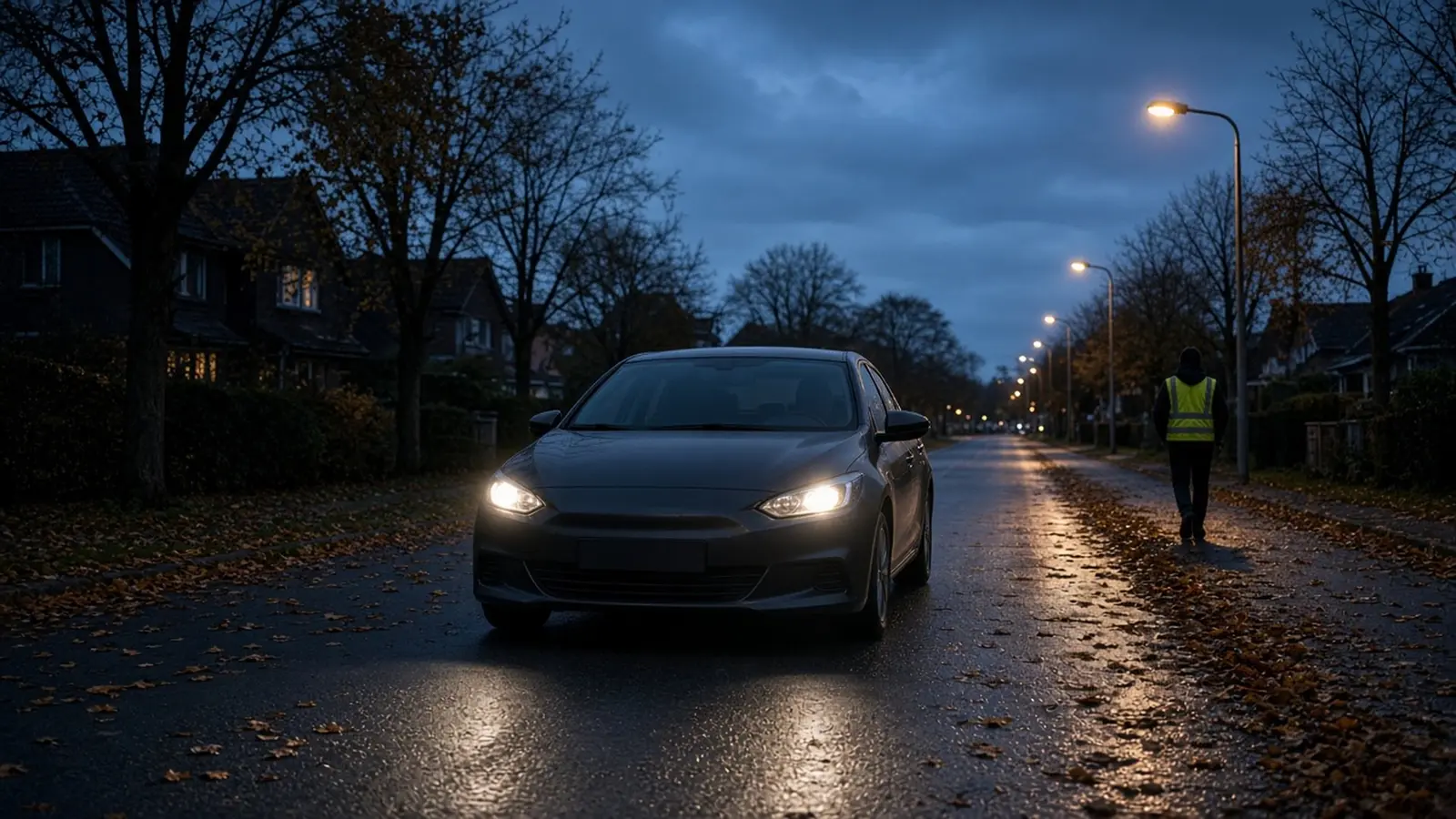
For a driver, what happens on Monday matters more. If you drive to and from work at the same clock time, after the change you suddenly find yourself in the dark on a stretch you knew in twilight only a week earlier. The evening drive home moves into dusk or full darkness, and with it your encounters with pedestrians, cyclists and children returning from school or after-school activities.
Your body takes several days to get used to the new rhythm. In the first days after the change, expect to be more tired and expect other road users to react more slowly than you are used to. On a familiar route it is easy to stop paying attention exactly where it is needed most.
What the law says about lights
The basic rule is in § 32 of the Slovak Act No. 8/2009 Coll. on Road Traffic. While driving, a vehicle must have its dipped headlights or equivalent lighting switched on. Daytime running lights may replace dipped headlights only in unreduced visibility, and only if the vehicle is fitted with them.
The same act defines reduced visibility as a situation in which road users cannot see each other or objects on the road clearly enough, in particular from dusk to dawn, in fog, snow, rain and in a tunnel. After the clock change, both the morning and the evening commute often fall into exactly this situation, and daytime running lights are no longer enough.
This is where the most common mistake happens. Many cars have the light switch in the automatic position, and the driver feels the lights are on because the daytime running lights are lit at the front and the instrument panel is illuminated. On some vehicles, however, daytime running lights do not switch on the rear position lights, so the car is almost invisible from behind at dusk. Check the owner’s manual to see how your car behaves, and in twilight switch to dipped headlights manually.
The law prohibits the use of main beams if the road is sufficiently and continuously lit or if they could dazzle an oncoming driver, the driver in front of you or another road user. Under § 32 you may use front and rear fog lights only in fog, snow or rain. A rear fog light switched on on a dry road dazzles whoever is behind you and does not comply with the rules.
Clean, working and correctly adjusted headlights
In § 32(5) the act also addresses the condition of the lights: the light-emitting surface of the prescribed headlights and lamps must not be covered or excessively dirty. In autumn, headlight lenses are quickly covered with a thin layer of mud and salt from road spray. Such a film may not look serious at first sight, but it scatters the light sideways and reduces the beam range exactly where you need it.
Before a longer drive in the dark, take a quick walk around the car. Switch on the dipped headlights, indicators and hazard lights and check that both sides work. A second person can help you check the brake lights, or you can use the reflection in a garage door or shop window. A blown bulb on one side turns your car into a motorcycle for oncoming drivers and distorts their judgement of distance.
- Clean the headlights and rear lights every time you refuel, not only when you wash the whole car.
- If your car has manual headlight levelling, set it according to the load. With a full boot and passengers in the back, the beam points higher and dazzles.
- Have fogged or yellowed plastic headlight covers assessed at a workshop. A matt surface significantly reduces the beam range.
- When replacing a bulb, ideally replace both sides at once so that they have the same colour and intensity.
- If you are not sure about your headlight alignment, have it checked on a testing device at a workshop.
The windscreen matters too. A greasy film on the inside of the glass catches the light of oncoming cars at night and creates a veil through which you can barely see a pedestrian at the roadside. Clean the windscreen inside and out and check the wipers. A blade that leaves streaks on the glass is a real obstacle to your view when driving at night in the rain. Top up the washer reservoir with winter fluid before the first frosts arrive.
Pedestrians and cyclists in the dark
After the clock change, encounters with pedestrians change the most. People walk home from work, bus stops and shops in the dark, often in dark winter clothing. In § 52 the act requires a pedestrian walking on the hard shoulder or along the edge of the carriageway in reduced visibility to wear visibly placed reflective elements or a reflective safety garment. In practice, however, many pedestrians do not comply, and drivers must take that into account.
Under § 32, non-motorised vehicles, including bicycles, must have their lights switched on in reduced visibility. As with pedestrians, not every cyclist has a working light and reflective elements. On roads outside built-up areas without street lighting, you often spot an unlit cyclist or a pedestrian dressed in dark clothes only at the last moment.
This leads to a few practical habits. When driving in the dark, adjust your speed so that you can stop within the distance you can see. Slow down at pedestrian crossings, bus stops and schools, even if you see no one. If an oncoming car dazzles you, look towards the right edge of the road and slow down smoothly rather than sharply. And when you get out of the car at the roadside outside a built-up area, remember the reflective vest you carry in the car.
A short checklist for the week after the clock change
The clock change is a good reminder to prepare your car for the dark months all at once, not bit by bit as each problem surprises you. You can manage the following points in one afternoon, and most of them without tools.
- Check all lights, including the brake lights, reversing lights and number plate lighting.
- Clean the headlights, rear lights and windscreen inside and out.
- Replace worn wiper blades and top up the washer reservoir with winter fluid.
- Find out in the manual when your car switches on the dipped headlights and rear lights automatically, and in twilight switch them on manually.
- If you have manual headlight levelling, learn to use it according to the load in the car.
- Expect more pedestrians and cyclists in the dark and adjust your speed and following distance.
Even the best lights are no substitute for attention. For the first two weeks after the clock change, drive as if you did not know the route. Other road users are getting used to the dark just as you are, and one person’s mistake is often saved by the other driving more slowly and seeing further.
Key takeaways
- The switch to Central European Time takes place on Sunday 25 October 2026 at 3:00, when clocks go back to 2:00.
- Daytime running lights may replace dipped headlights only in unreduced visibility, not from dusk to dawn.
- Fog lights belong only in fog, snow or rain, and main beams must not dazzle anyone.
- Headlights must not be covered or excessively dirty, so clean them regularly and check the bulbs.
- Pedestrians and cyclists are often hard to see in the dark, so adjust your speed and slow down at crossings and stops.
FAQ
- Are daytime running lights enough in the dark?
- No. Under § 32 of Act No. 8/2009 Coll., daytime running lights may replace dipped headlights only in unreduced visibility. From dusk to dawn, in fog or in rain you must use your dipped headlights.
- When may I switch on the rear fog light?
- Only in fog, snow or rain. On a dry road at night it dazzles the driver behind you.
- When exactly do the clocks change in 2026?
- In the night from Saturday 24 to Sunday 25 October 2026. At 3:00 summer time the clocks go back to 2:00 Central European Time.
Comments
No comments yet. Be the first.
Add a comment
Your comment appears once the editors approve it. We never publish your email.
Do you sell cars?
A website for your dealership with a stock list that syncs itself from the listing portals. In 8 languages, ready in minutes.
30 days free, no card


