In this article
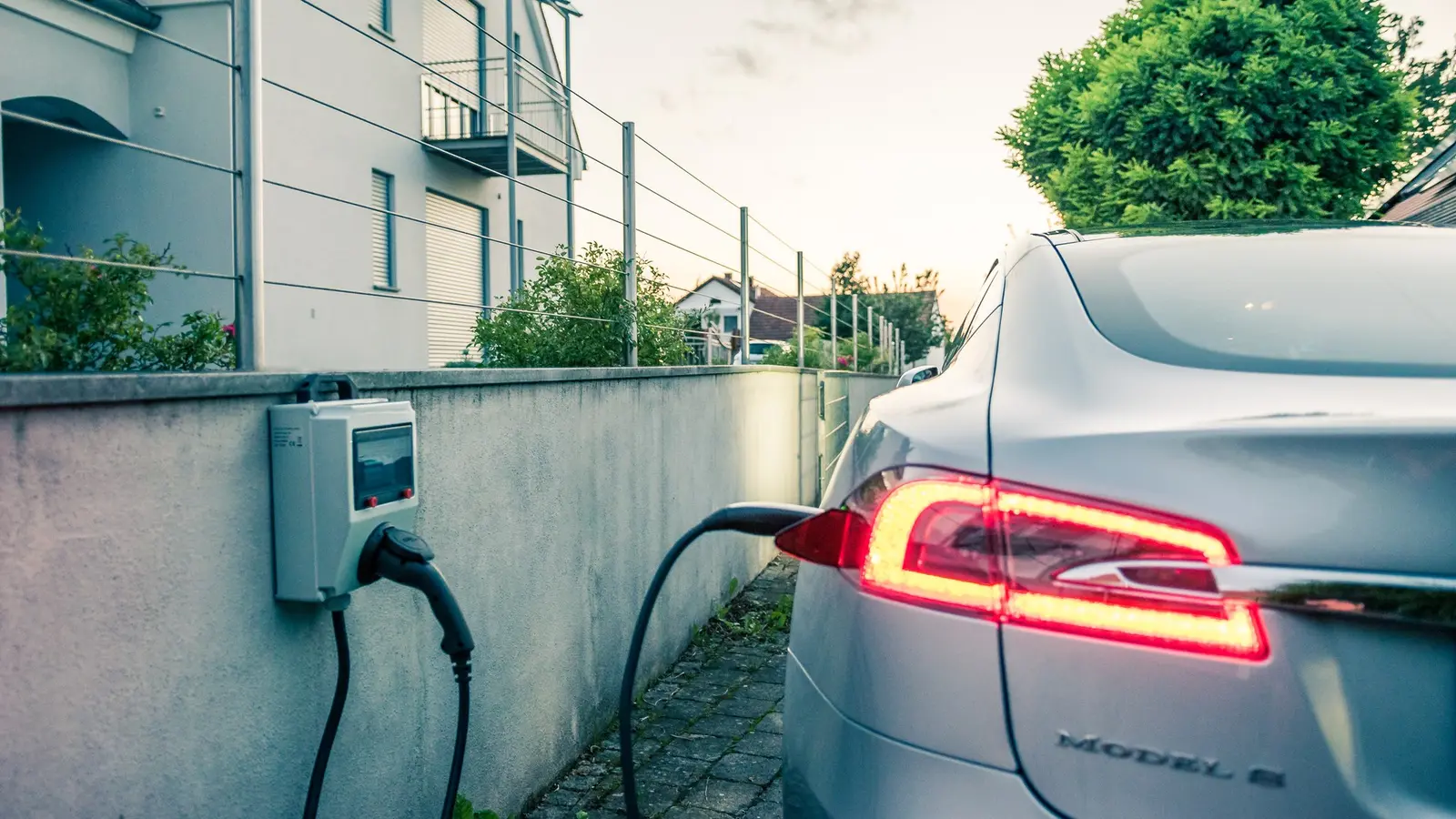
Anyone who owns an electric car and has a parking space at home does most of their charging there. It is the most convenient and usually also the cheapest way, provided the installation is designed properly. A home wall charger, commonly called a wallbox, is not an appliance that you simply plug into a socket, however. What matters is the power that both the car and the home connection can handle, the type of cable, protection against electric shock and, increasingly, the ability to charge smartly. This guide explains what to look at before buying, what belongs in the installation and which rules apply throughout the European Union.
A household socket as an emergency solution
Almost every electric car can also be charged from an ordinary socket using a portable cable with a control and protection unit built into the cable. The international standard IEC 61851-1 calls this method Mode 2, and the in-cable unit itself (IC-CPD) is covered by IEC 62752. The unit monitors the protective earth conductor, the current and the temperature, but the socket and the household circuit remain the same as for ordinary appliances.
The German motoring club ADAC points out that household wiring is usually not designed for long hours at full load, and that regular charging from a socket risks overheating and even a cable fire. A socket delivers around 2.3 kW, so charging takes a long time. The ADAC states, for example, that a Volkswagen ID.3 takes almost 16 hours to charge fully from a socket, but roughly 5 hours with an 11 kW wallbox.
Slow charging also costs more energy. In ADAC measurements, charging losses were between 6 and 10% with a wallbox, depending on the car, and between 13 and 24% with a socket. This is because the car’s control units run for longer during slow charging. A socket is therefore a sensible backup for trips or occasional top-ups, not a permanent solution.
One phase or three: what power makes sense
The power of home charging is determined by the number of phases and the current per phase. The table shows typical values at the European voltage of 230/400 V.
| Connection | Current per phase | Approximate power |
|---|---|---|
| single phase | 16 A | 3.7 kW |
| single phase | 32 A | 7 kW |
| three phases | 16 A | 11 kW |
| three phases | 32 A | 22 kW |
With alternating-current (AC) charging, the car’s on-board charger converts the current to direct current. It determines how much the car actually accepts. The ADAC puts it simply: the power is always limited by the weakest link of the three, namely the wallbox, the cable and the car. Plug-in hybrids are often limited to 3.6 to 3.7 kW, and the same applies to some electric cars; the ADAC cites the Nissan Leaf as an example.
The most popular choice is an 11 kW wallbox. According to the ADAC, it is perfectly adequate for overnight charging, and its requirements can be met without difficulty in many households. A 22 kW wallbox only makes sense if the car can use it. Only some models have a 22 kW on-board charger, often only as an extra-cost option; one example is the Renault Zoe. Such a wallbox draws up to 32 A on each phase, so the home connection must be sized for it.
You can calculate an approximate charging time easily: divide the battery capacity in kWh by the power in kW. In theory, a 50 kWh battery charges at 22 kW in roughly 2.3 hours; in practice, temperature, battery condition and losses all play a part. Most cars stand at home all night, however, so higher power brings less benefit than it might seem.
Type 2 connector and Mode 3 cable
A wallbox charges in Mode 3 under IEC 61851-1. Unlike a socket, the charger and the car exchange information via a control signal in the cable: the wallbox checks that the car is connected and the protective earth conductor is working, tells the car how much current it may draw, and only switches on the voltage when both sides are ready.
The standard in Europe is the type 2 connector. Regulation (EU) 2023/1804 on the deployment of alternative fuels infrastructure (AFIR) prescribes it in Annex II for normal-power AC charging points, i.e. up to 22 kW, with reference to the EN 62196-2 standard. The regulation is aimed mainly at public charging infrastructure, but home wallboxes use the same connector, which is why ordinary electric cars sold in the EU fit them.
When choosing, note whether the wallbox has a permanently attached cable or only a type 2 socket for your own cable. A fixed cable is more convenient for everyday charging; a socket is useful if you want to replace the cable or carry it with you. If you want to charge at 22 kW, the cable must also be rated for that power.
Safe installation and inspection of the wiring
A wallbox should be installed by a qualified electrician. Before installation, they should assess whether the home connection and the distribution board can handle another continuous load. The international standard IEC 60364-7-722 for supplies for electric vehicles assumes that every charging point operates at its full rated current in normal use.
The same standard sets out several requirements worth asking your electrician about:
- Dedicated circuit. The charger has its own supply with its own circuit breaker and does not share it with sockets or other appliances.
- Its own residual current device. Each charging point is protected by a separate residual current device (RCD) with a tripping current of no more than 30 mA, at least type A.
- Protection against DC fault current. The car’s on-board charger can generate a DC fault current to which an ordinary RCD may not respond. This is addressed either with a type B RCD or with a type A or F RCD combined with a device that disconnects charging at a DC fault current of 6 mA or more (RDC-DD under IEC 62955).
Many wallboxes have 6 mA DC fault current detection built in. The manufacturer states this in the technical documentation. Easee, for example, writes for its Charge Lite model that the charger disconnects at a DC fault current above 6 mA and, in a fixed installation, requires an upstream type A RCD. Always follow the installation instructions for the specific model.
Older distribution boards also need attention. According to the Schneider Electric installation guide based on IEC 60364-7-722, a type AC RCD must not be installed upstream of the charging circuit, and a type A or F RCD may be upstream of no more than one charger with a type A RCD and 6 mA detection. Otherwise, DC fault current could “blind” such an RCD, and it would not trip in the event of a real fault.
After installation, have the installation tested and handed over with an inspection certificate in line with the rules of your country. Also ask for the manufacturer’s declaration of conformity, which, according to the ADAC, confirms that the manufacturer guarantees the product complies with applicable EU law. Whether a wallbox has to be notified to the distribution system operator, and from what power its consent is required, varies from country to country, so check with your network operator in advance.
Smart charging and what EU law changes
The AFIR regulation defines smart charging as charging in which the power delivered to the battery is adjusted in real time based on information received through electronic communication. In practice, this means the wallbox can charge during hours when electricity is cheaper, adapt its power to the rest of the household’s consumption, or charge from surplus solar power. The ADAC points out that home solar systems often do not deliver the full 11 kW, so it is an advantage if the wallbox can reduce its power continuously.
European legislation confirms this direction:
- Directive (EU) 2023/2413 (RED III) requires Member States to ensure that new and replaced non-publicly accessible normal-power charging points support smart charging. Member States had to transpose it by 21 May 2025.
- Directive (EU) 2024/1275 on the energy performance of buildings requires new residential buildings with more than three parking spaces to have pre-cabling for at least half of the spaces, ducting for cables for the rest and at least one charging point. A tenant’s or co-owner’s request for a charging point at their parking space may only be refused on serious and legitimate grounds. The deadline for transposing these rules into national law expired on 29 May 2026.
- Directive (EU) 2019/944 on the internal market for electricity allows a customer with a smart meter to request a dynamic electricity price contract from at least one supplier and from every supplier with more than 200,000 customers.
When buying, therefore, give preference to a wallbox that can be controlled via an open communication protocol or an app, can limit its power and ideally also work with the meter and the solar system. A brief checklist before ordering: find out the maximum AC power of the car’s on-board charger, have an electrician assess the connection and the distribution board, choose the power according to how long the car stands at home, check the RCD type and the 6 mA detection, and keep the instructions, the declaration of conformity and the inspection certificate.
Key takeaways
- According to the ADAC, a Volkswagen ID.3 takes almost 16 hours to charge from a household socket (around 2.3 kW), but roughly 5 hours with an 11 kW wallbox, and with smaller energy losses.
- An 11 kW wallbox (three phases at 16 A each) is usually enough for overnight charging; 22 kW only makes sense if the car’s on-board charger supports it.
- Under IEC 60364-7-722, each charging point has its own circuit and a residual current device of up to 30 mA, either type B or type A with 6 mA direct-current detection.
- Directive (EU) 2023/2413 requires new and replaced normal-power home charging points to support smart charging.
FAQ
- Can I charge my electric car at home from a socket alone?
- Occasionally, yes, using a Mode 2 cable with a protection unit. The ADAC does not recommend it for regular charging: a socket delivers around 2.3 kW, charging losses in its measurements were between 13 and 24%, and household wiring is not designed for long hours at full load.
- Is a 22 kW wallbox worth it?
- Only if the car has a 22 kW on-board charger and the home connection can handle 32 A on each phase. According to the ADAC, most cars charge with alternating current at no more than 11 kW, and if the car stands at home all night, 11 kW is usually enough.
- What residual current device does a home charger need?
- Under IEC 60364-7-722, each charging point needs its own RCD of up to 30 mA, at least type A. In addition, protection against DC fault current is required: either a type B RCD or 6 mA detection, which many wallboxes have built in. The manufacturer’s installation instructions and the electrician’s assessment are decisive.
Comments
No comments yet. Be the first.
Add a comment
Your comment appears once the editors approve it. We never publish your email.
Do you sell cars?
A website for your dealership with a stock list that syncs itself from the listing portals. In 8 languages, ready in minutes.
30 days free, no card