In this article
The third generation after twenty years
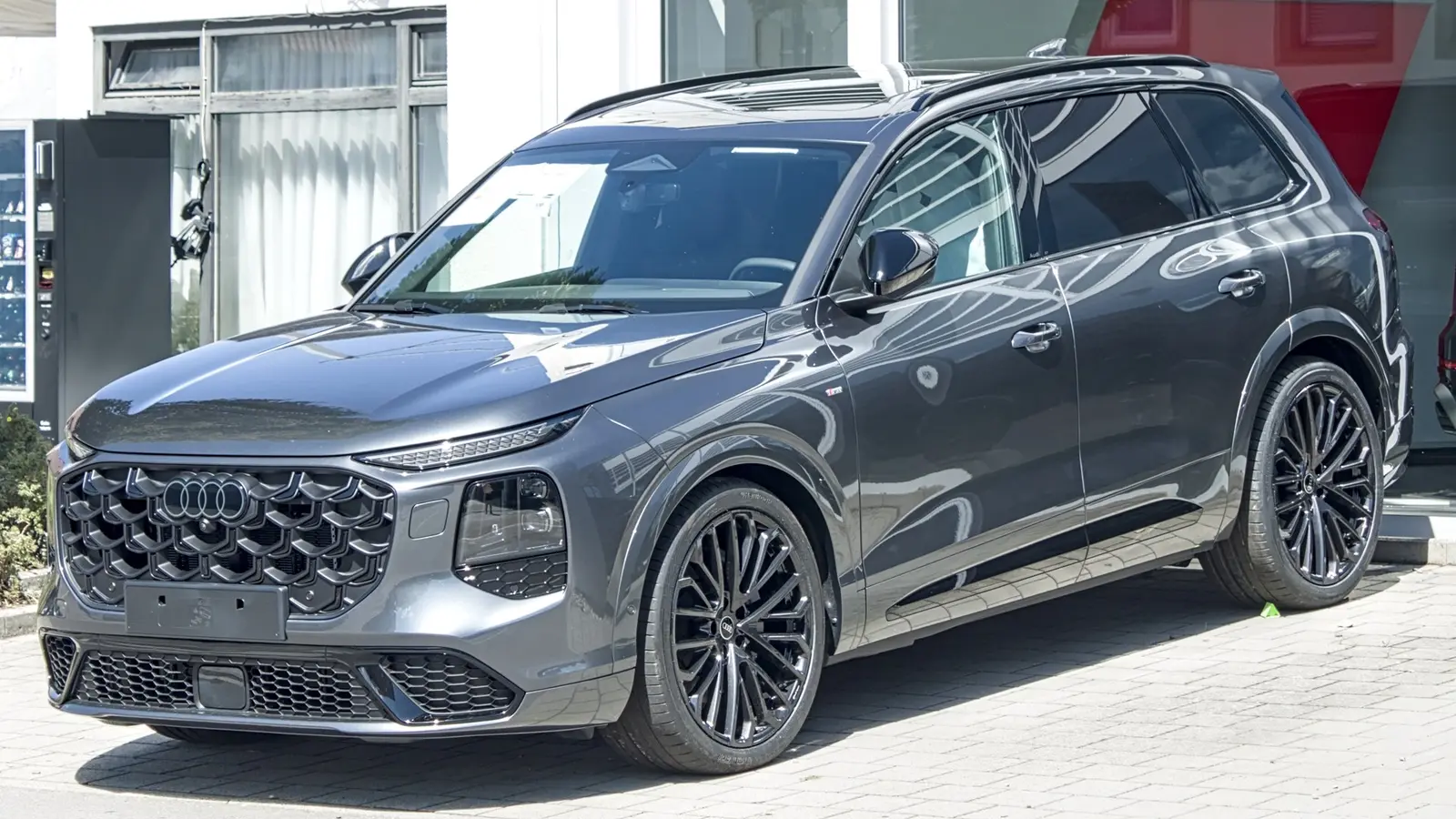
Audi Q7 has been on the market since 2005. In June 2026, Audi presented its third generation, and in October 2026 it was tested by Euro NCAP. The result: five stars and, as the first series-production car, a full 100% in the post-crash safety category. We give an overview of what is different about the new Q7, which powertrain it launches with and why the post-crash rating is of particular interest to firefighters and rescuers.
In its third generation, the Q7 is again built in Bratislava, just like both previous generations. The technical data in this article are the manufacturer’s figures; the test results come from the public Euro NCAP protocol.
What is new on the new Q7
According to Audi, the body is 5,056 mm long and 2,010 mm wide, with a wheelbase of 2,994 mm. The basic layout has five seats; at extra cost there is a six-seat version with two individual seats in the second row or a seven-seat version, which can take three child seats. All seats are electrically adjustable.
- Luggage space: the five-seat Q7 offers up to 806 litres, and up to 2,075 litres with the second row folded. The seven-seat version offers up to 722 litres behind the second row.
- Lights: optional digital Matrix LED headlights with micro-LED modules, third-generation digital OLED lights at the rear and up to eight light signatures. A new feature is a turn signal projected onto the road at night, intended to warn cyclists, for example, in good time.
- Roof: the top trim level has an illuminated panoramic glass roof with switchable transparency; Audi states that it is not yet available at the start of sales.
- Assistants: the car can memorise up to five parking manoeuvres of up to 200 metres, and the reversing assistant repeats roughly 50 metres of a route at up to 10 km/h.
Powertrain: V6 diesel with mild hybrid
At the start of sales, Audi offers only the three-litre V6 TDI diesel with MHEV plus technology. A generator in the transmission temporarily adds up to 18 kW and, when manoeuvring or in queues, allows short stretches of partly electric driving. The eight-speed tiptronic automatic and permanent quattro drive with a new self-locking centre differential are standard.
| Version | Power | Torque |
|---|---|---|
| Q7 TDI quattro 180 kW | 180 kW (245 hp) | 500 Nm |
| Q7 TDI quattro 220 kW | 220 kW (299 hp) | 630 Nm |
Combined WLTP consumption for the whole range is 7.1 to 8.0 l/100 km. According to ADAC, the less powerful version accelerates from 0 to 100 km/h in 7.2 s, reaches 222 km/h and can tow trailers of up to 3,500 kg. In its list of variants, Euro NCAP states that the rating also applies to the petrol Q7 TFSI with 270 kW and to the eHybrid plug-in hybrids with 290 and 360 kW; however, these are not offered at the start of sales.
Euro NCAP: five stars and 100% post-crash
Since 2026, Euro NCAP has rated cars in four stages, each on a 100-point scale. It published the result on 12 October 2026 and tested a Q7 TDI quattro 220 kW with a kerb weight of 2,380 kg.
| Assessment stage | Q7 result |
|---|---|
| Safe driving | 72% |
| Crash avoidance | 77% |
| Crash protection | 88% |
| Post-crash safety | 100% |
The protocol also lists weaker points. Detection of a child left in the car is not standard, and the car does not recognise a front passenger sitting with their feet on the dashboard. Head protection for a struck cyclist is weak, and in a frontal collision the Q7 is, according to Euro NCAP, a “somewhat aggressive” partner for the other car. By contrast, the speed-limit recognition system correctly identified the limit in 87% of cases on a route of roughly 2,000 km.
What the post-crash rating means for rescuers
The post-crash safety category looks at the first minutes after a crash, the so-called golden hour. Of the total 100 points, 40 go to information for rescuers, 25 to the car’s intervention immediately after the crash and 35 to extricating the occupants. The Q7 achieved the maximum in all three parts.
- Emergency call: under Regulation (EU) 2015/758, new types of passenger cars in the EU must have the mandatory eCall emergency call to 112 from 31 March 2018. In addition to the mandatory data on the occupants and the type of impact, Audi also sends the make, model and colour of the car and a more precise location. Euro NCAP rates this extended service separately.
- Brake against secondary collisions: after a serious impact, the car brakes itself to a standstill, secures itself with the parking brake and switches on the hazard lights. The driver can override the braking.
- Extrication: Euro NCAP checks whether the doors open from outside and inside after an impact, whether they work if the on-board power fails and whether the seat belts can be unbuckled.
- Rescue sheets: model sheets and guides show where the airbags, pretensioners and reinforcements are located and where the body can be cut safely.
This gives buyers a practical tip: if a car offers an extended emergency call service linked to a phone, it is worth activating it and agreeing to call-backs.
When the new Q7 is on the market
Audi opened orders in June 2026, and deliveries began in September 2026. Prices, equipment and exact dates vary by country, so please check them with an Audi dealer in your country.
Key takeaways
- The third-generation Audi Q7 is 5,056 mm long, has five, six or seven seats and is built in Bratislava.
- At the start of sales, the only engine is the V6 TDI diesel with MHEV plus, rated at 180 kW (500 Nm) or 220 kW (630 Nm), with quattro drive.
- Euro NCAP awarded five stars: 72% for safe driving, 77% for crash avoidance, 88% for crash protection and 100% for post-crash safety.
- The Q7 is the first series-production car to score 100% for post-crash safety, thanks to an extended emergency call, a brake against secondary collisions and data for rescuers.
- Orders opened in June 2026 and deliveries began in September 2026; prices and equipment vary by country.
FAQ
- What rating did the new Audi Q7 receive from Euro NCAP?
- Five stars. According to Euro NCAP, it scored 72% for safe driving, 77% for crash avoidance, 88% for crash protection and 100% for post-crash safety.
- What does Euro NCAP assess in the post-crash safety category?
- Information for rescuers (40 points), the car’s intervention after a crash, such as an extended emergency call and a brake against secondary collisions (25 points), and extrication of the occupants, including opening the doors and seat belts (35 points).
- Which engines does the new Audi Q7 have?
- At the start of sales, a three-litre V6 TDI diesel with MHEV plus mild hybrid technology, rated at 180 kW and 500 Nm or 220 kW and 630 Nm, always with an automatic transmission and quattro drive.
- When is the new Audi Q7 on the market?
- Audi opened orders in June 2026, and deliveries began in September 2026. Prices and dates vary by country.
Comments
No comments yet. Be the first.
Add a comment
Your comment appears once the editors approve it. We never publish your email.
Do you sell cars?
A website for your dealership with a stock list that syncs itself from the listing portals. In 8 languages, ready in minutes.
30 days free, no card


