In this article
A tyre can have plenty of tread and still be at the end of its service life. Rubber ages even when the car stands in the garage or when a set of winter tyres rests in the cellar. The good news is that you can find out a tyre’s age in a few seconds: simply find the four-digit date of manufacture on the sidewall. In this article we explain how to read it, what the rules that apply across the EU say, what age manufacturers and motoring clubs recommend, and how to store tyres so that they age as slowly as possible.
How to read the DOT code and the date of manufacture
On the sidewall of the tyre you will find a longer string of characters, which often begins with the letters DOT. This is the tyre identification number: the first groups of characters identify the factory and the type, but for the driver only the last group matters. It is usually set slightly apart and often framed in a small oval. It consists of four digits: the first two are the week of manufacture, the last two the year of manufacture.
- 4523 means week 45 of 2023, i.e. the beginning of November 2023.
- 0816 means week 8 of 2016. In November 2026, such a tyre is more than ten years old.
- A three-digit code (for example 459) comes from tyres made before 2000, when the year was given by a single digit. Do not fit such a tyre for road use.
The date is often printed on one side only. If you cannot see it on the outside, look at the inner side of the wheel or ask the tyre shop to show it to you when the tyres are changed.
What the rules that apply across the EU say
The obligation to mark the date of manufacture comes from UNECE Regulation No. 30 on the approval of tyres for passenger cars, which the EU has adopted. Under it, a tyre must carry the date of manufacture in the form of four digits, the first two indicating the week and the last two the year. Before 1 January 2000, the date could have three digits.
Wear is governed by Directive 89/459/EEC: passenger car tyres must have a tread depth in the main grooves of at least 1.6 mm. This applies throughout their use on the road. European rules, however, set no maximum tyre age. As ADAC also points out, there is no generally applicable rule on tyre age, and you will not find a best-before date on a tyre as you would on food. The decision to replace an old but little-worn tyre is therefore left to the driver and to the manufacturers’ recommendations.
What age manufacturers and motoring clubs recommend
Although the law does not set an age, manufacturers and clubs agree on similar limits:
- Michelin recommends that after 5 years of use, tyres be checked by a specialist at least once a year. If they have not been replaced within 10 years of the date of manufacture, it recommends replacing them with new ones as a precaution, including the spare.
- Continental advises retiring all tyres, including the spare, that were made more than ten years ago, even if they look fine and the tread is above the legal limit. According to the manufacturer, the driver cannot rely on a visual check for cracks and wear alone.
- ADAC states that passenger car tyres should be used for no more than ten years, summer tyres for no more than eight to ten years and winter tyres for no longer than eight years.
The reason is simple: the rubber compound hardens over time. According to ADAC, this shows mainly in poorer grip and longer braking distances on wet roads. The club’s tests with unused new tyres of different ages showed that technical properties can deteriorate over the years even if the tyre has never been driven on.
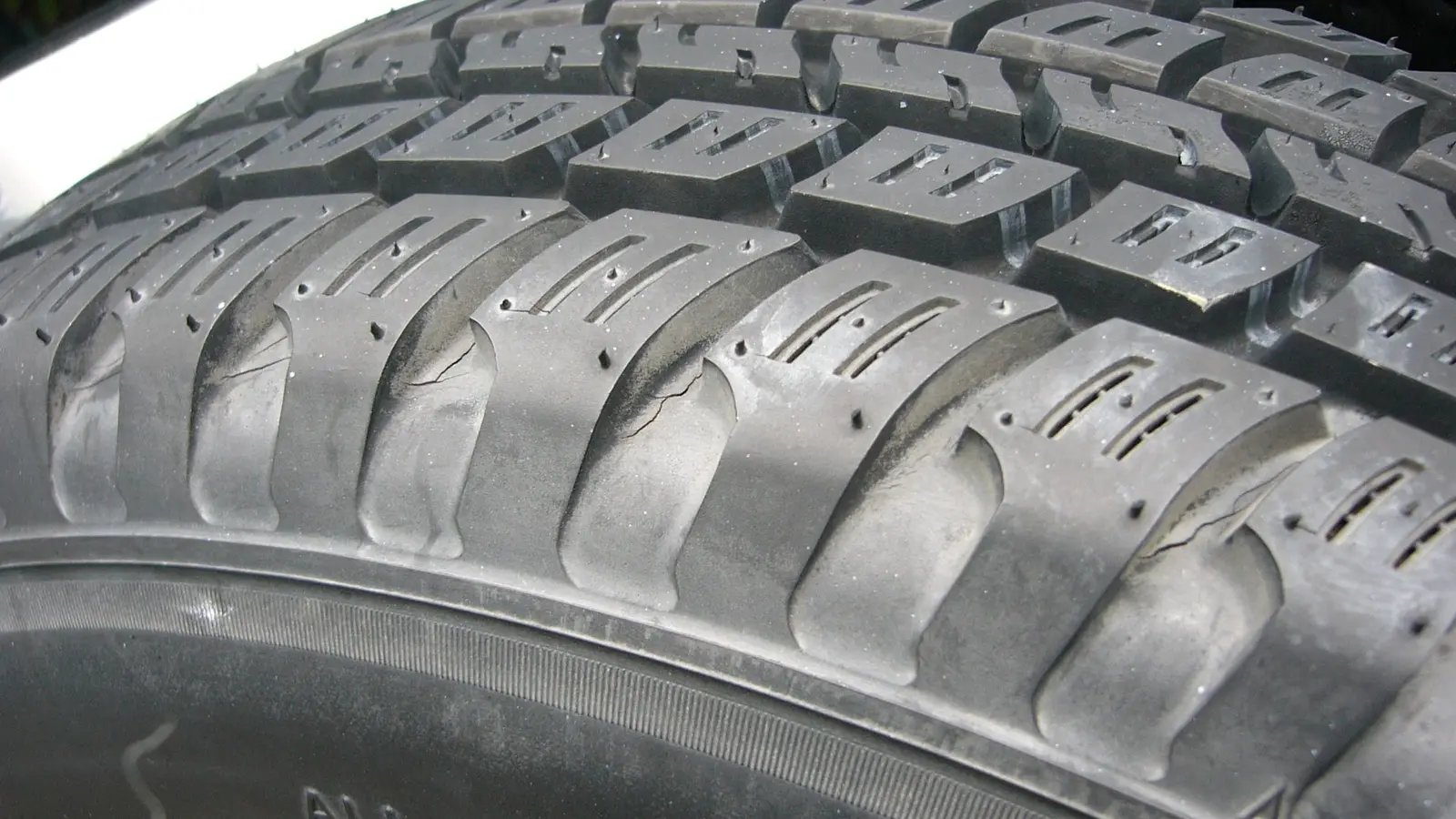
Age is not the only criterion, however. A tyre should be replaced sooner if its tread is below the legal limit or if it has visible cracks, bulges or cuts on the sidewall. For summer tyres, ADAC recommends replacing them at a tread depth of around 3 mm, even though the legal minimum is 1.6 mm.
Date of manufacture versus date of fitting
A tyre’s age is counted from the date of manufacture, not from the day it was fitted to your car. Michelin and Continental both state their limits based on the date stamped on the sidewall. So a new tyre need not be “fresh”: if it has spent several years in a warehouse, part of its life is already behind it.
When buying, it is therefore worth checking the DOT code before fitting. ADAC recommends that, at purchase, a new tyre should be no more than two years old, and advises telling the dealer so when you order. According to the club, a tyre made five years ago is too old to be sold as new. With a used car or when buying a used set, checking the date is even more important: four tyres with good tread but from 2015 and 2016 will serve you only briefly under today’s recommendations.
This also applies to the spare. It often goes unused for years, yet it ages just like the other tyres. Michelin and Continental both explicitly include it in the ten-year limit.
How to store tyres so that they age more slowly
Correct storage does not stop ageing, but it slows it down considerably. For storing a set out of season, Continental recommends these principles:
- Wash the tyres before storage and let them dry completely, including the rims if you store them mounted.
- The place should be cool, dry, moderately ventilated and out of direct sunlight. Never store tyres outdoors, not even under a tarpaulin.
- Protect them from heat sources and from fluctuations in temperature and humidity, which are common in many garages, sheds and attics.
- Store tyres without rims upright. Never hang them, as they could become deformed.
- Tyres on rims are better stacked on top of each other in a low pile or hung on a rack or hooks.
- Airtight bags reduce the evaporation of oils from the rubber compound.
Before the next season, Continental recommends having the tyres checked by a specialist. If you do not have a suitable place, the manufacturer recommends leaving storage to a tyre dealer.
Winter tyres and age: what to watch out for
With winter tyres, age is even more critical. Their compound has to stay soft at low temperatures, and ADAC states that they lose some of their winter properties after about six years. The club therefore advises against driving on winter tyres older than eight years. When switching to winter tyres, check not only the tread depth but also the DOT code. We explain what the three-peak mountain snowflake symbol 3PMSF means and how to read the EU label in the article Winter tyres: what 3PMSF and the EU label mean.
A quick routine before the season:
- Find the last four digits of the DOT code on each tyre and work out its age.
- Plan to replace winter tyres older than eight years and any tyres older than ten years.
- Have tyres older than five years checked at a tyre shop at least once a year.
- Check the tread depth (the legal minimum is 1.6 mm) and look for cracks and bulges on the sidewalls.
- When buying new tyres, make sure they are no more than two years old.
A few minutes when changing tyres is enough to make sure you are not driving on tyres that look fine but whose rubber no longer has the properties you rely on in winter.
Key takeaways
- The last four digits of the DOT code are the week and year of manufacture: 4523 means week 45 of 2023.
- EU rules require the date of manufacture on the tyre and a tread depth of at least 1.6 mm, but they set no maximum age.
- Michelin and Continental recommend replacing tyres, including the spare, within 10 years of manufacture; Michelin advises an annual check from 5 years.
- ADAC advises against winter tyres older than 8 years, and a new tyre should be no more than 2 years old when you buy it.
- Age is counted from manufacture, not from fitting; cool, dry and dark storage slows ageing.
FAQ
- Where on the tyre can I find the date of manufacture?
- On the sidewall, as the last four digits of the DOT code, often in a small oval. The first two digits are the week, the last two the year of manufacture. The date is sometimes on one side only, so check the inner side of the wheel as well.
- Does EU law set a maximum tyre age?
- No. UNECE Regulation No. 30 requires the date of manufacture to be marked and Directive 89/459/EEC sets a minimum tread depth of 1.6 mm, but neither sets a maximum age. Follow the manufacturers’ recommendations, which agree on a limit of 10 years from manufacture.
- Is tyre age counted from manufacture or from fitting?
- From the date of manufacture. Michelin and Continental both base their recommendations on the date on the sidewall. ADAC therefore advises buying new tyres that are no more than two years old.
- How long can I drive on winter tyres?
- ADAC states that winter tyres lose some of their winter properties after about six years and advises against using winter tyres older than eight years, even if they have sufficient tread.
Comments
No comments yet. Be the first.
Add a comment
Your comment appears once the editors approve it. We never publish your email.
Do you sell cars?
A website for your dealership with a stock list that syncs itself from the listing portals. In 8 languages, ready in minutes.
30 days free, no card


