In this article
M+S: a tread marking, not a snow test
When you look at a tyre’s sidewall before winter, the abbreviation you will most often find is M+S, or its variants M.S or M&S. It comes from the English “mud and snow”. UN ECE Regulation No. 30, which applies throughout the European Union, defines such a tyre by its design: its tread pattern and structure must perform better in mud and in fresh or melting snow than a normal road tyre. The tread usually has wider grooves or more pronounced blocks.
What matters is what this definition leaves out. M+S on its own does not say that the tyre has passed a braking or traction measurement on snow. The marking is based on the tread design, not on a test result. That is why you will also find it on some all-season tyres or SUV tyres designed more for mud and light off-road use than for a snowy mountain road. For the driver this means one thing: M+S is useful information, but not a guarantee of winter performance.
The alpine 3PMSF symbol: a tyre that has passed a test
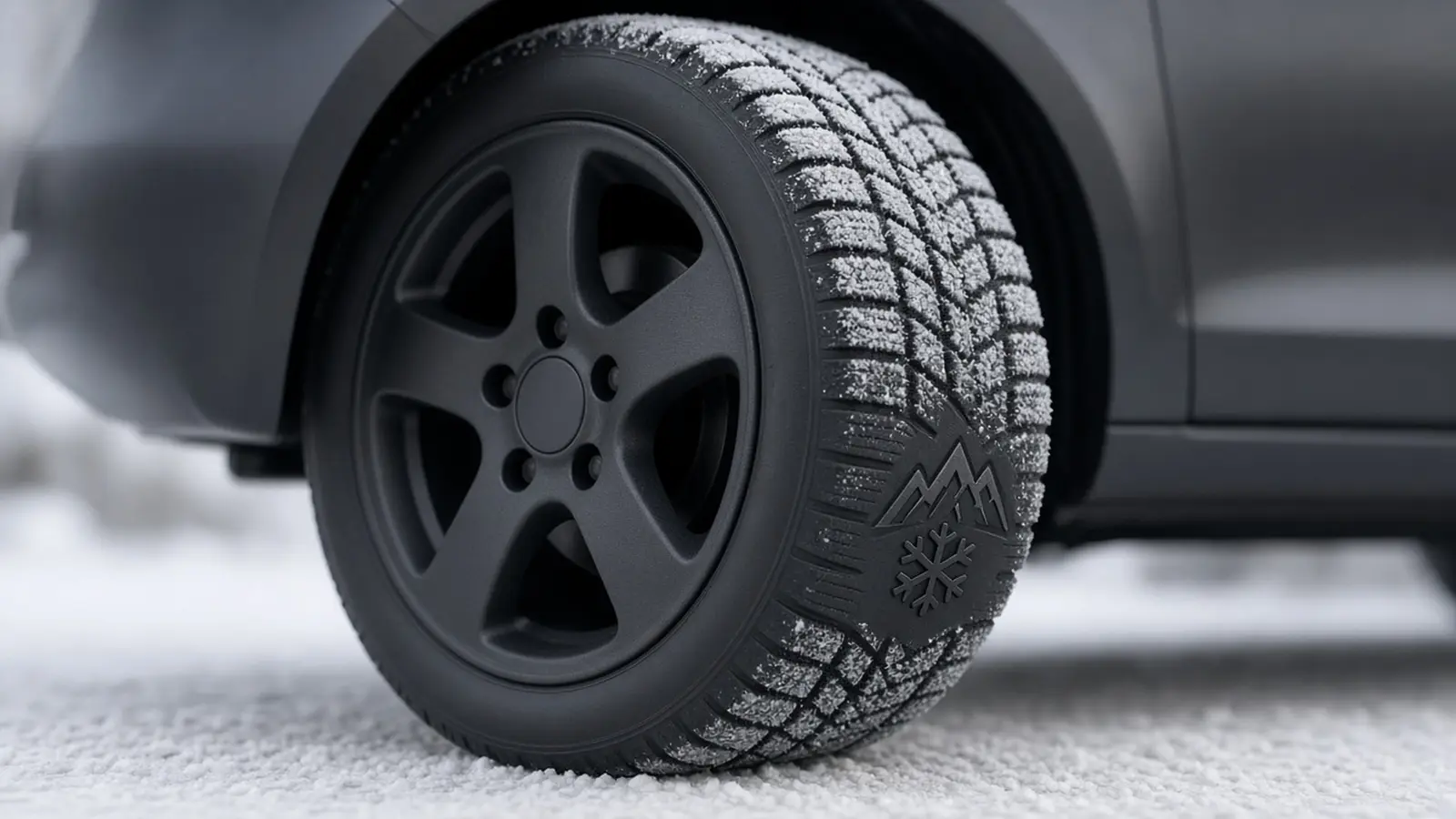
A more reliable guide is the pictogram of three mountain peaks with a snowflake. Its technical name is 3PMSF (three-peak mountain snowflake), and the regulations call it the alpine symbol. It may only be carried by a tyre that UN ECE Regulation No. 117 classifies as a tyre for use in severe snow conditions. To qualify, it must meet minimum snow index values.
The test compares the tyre with a standard reference test tyre (SRTT). For passenger car tyres, class C1, the snow braking method measures the vehicle’s deceleration on packed snow, and the result must reach an index of at least 1.07. In other words, the tested tyre must brake better on snow than the reference tyre. For light commercial vehicle and truck tyres, other methods are used, such as measuring traction or acceleration.
The alpine symbol is moulded directly into the sidewall and, since May 2021, it also appears on the EU label. So if you are choosing a tyre for winter, look for this pictogram. M+S is often found next to it as well, but what counts is whether the tyre has passed the snow test.
The EU label: what it tells you before you buy
Every new tyre for a car, van or truck sold in the EU must carry a label under Regulation (EU) 2020/740. The current version of the label has applied since 1 May 2021. The seller must show it to you before you buy, and if you buy a tyre online, the label must be available next to the price or the purchase button. Likewise, a new car dealer must give the customer the label information for the tyres fitted to the car.
| Label item | Scale | What it means for you |
|---|---|---|
| Rolling resistance (energy efficiency) | A to E | effect on fuel consumption or electric car range |
| Wet braking | A to E | braking distance on wet asphalt |
| External rolling noise | A to C and a value in dB | noise heard by people nearby when the car passes |
| Snow symbol (3PMSF) | yes or no | the tyre has passed the snow test |
| Ice symbol | yes or no | the tyre has passed the ice test |
Rolling resistance determines how much energy the car uses just to keep the tyre rolling. The European Commission states that a difference of one class can mean, over the tyre’s whole life, around 80 litres of fuel on average for a combustion car, or tens of kilometres of range per charge for an electric car.
Wet braking is the most important item on the label for safety. Class A means the shortest braking distance on wet asphalt. According to the Commission, a difference of one class can add 3 to 6 metres to the distance in an emergency stop. Remember, however, that this class is measured on a wet surface, not on snow or ice.
Noise is given in decibels and as a class. The Commission points out that a difference of 3 dB means twice as much noise. This is the noise heard by pedestrians and people living by the road, not noise in the cabin.
The label also carries a QR code. Scanning it opens the tyre’s entry in the European EPREL database, where you can compare models and check the label data. National authorities carry out random checks on manufacturers’ results.
The ice symbol: a tyre for Nordic winters
The second winter pictogram on the label resembles an ice stalagmite. It marks tyres for extremely cold conditions that stop in a shorter distance on a fully icy road. The test follows the ISO 19447 standard and applies only to passenger car tyres. A tyre with the ice symbol must also meet the snow requirements, so it also carries the alpine symbol.
The European Commission warns that these so-called Nordic tyres usually have very poor performance on wet surfaces. They are intended for Nordic countries and are not suitable for milder climates. If you mostly drive on wet, salted roads in winter, the ice symbol is not an advantage you should look for.
Tread depth and tyre age
Even the best winter tyre does not work when it is worn out. Council Directive 89/459/EEC sets a minimum tread depth of 1.6 mm in the main grooves for cars, light commercial vehicles and light trailers. The main grooves are the wide grooves in the central part of the tread, which covers about three quarters of its width. At the bottom of these grooves are small raised bars, the tread wear indicators. When the tread is worn down to their level, the tyre is at the legal minimum.
The legal minimum, however, is not the same as good grip. The Commission points out that as the tread wears, wet braking gets worse and the risk of aquaplaning rises. On snow, a tyre needs sufficiently deep grooves and sipes to grip the snow. Several countries therefore require a tread depth greater than 1.6 mm in the winter period. Before travelling abroad, check the requirements of each country you will pass through.
You can find out a tyre’s age from the code on the sidewall. UN ECE Regulation No. 30 requires the production date to be shown as a group of four digits: the first two give the week and the last two the year. The code 3824 therefore means week 38 of 2024. The European rules do not set an age after which a tyre must be replaced. When buying, though, check that you are not getting a tyre that has sat in a warehouse for years, and on older tyres already on the car, look for cracks in the sidewall and the grooves.
All-season tyres and national rules
An all-season tyre can carry the alpine symbol just like a winter tyre if it has passed the same snow test. When choosing an all-season tyre, the 3PMSF symbol is therefore a useful filter: it separates a model that has proven its snow performance from one that only has the M+S marking. An all-season tyre is always a compromise between summer and winter performance, and the label helps you compare where the manufacturer has set that compromise.
Road traffic rules are not uniform across the EU. The European Union’s Your Europe portal states that each country regulates the winter tyre obligation itself. Countries differ in the period when it applies and in which tyre markings they accept. If you travel through several countries in winter, check the rules in each of them, not just in your destination.
A short routine will help you when buying winter tyres. First check the size and the load and speed index that match your car. Then look for the alpine symbol on the sidewall and on the label. Compare the wet braking class, which is very important in winter at temperatures above zero, and only then rolling resistance and noise. Finally, check the production date.
Getting your car ready for winter: what to check now
Tyre age: how to read the DOT code and when to replace tyres
Key takeaways
- M+S describes a tread designed for mud and snow, but it is not confirmed by a test on snow.
- Only a tyre that brakes better on snow than the reference tyre in a test under UN ECE Regulation No. 117 may carry the alpine 3PMSF symbol.
- Under Regulation 2020/740, the EU label rates rolling resistance, wet braking and noise, and its QR code links to the EPREL database.
- The minimum tread depth in the EU is 1.6 mm, and the four-digit code on the sidewall reveals the production date.
- Each country decides on its own winter tyre obligation, so check the rules of every country on your route before you travel.
FAQ
- Is a tyre marked M+S enough for winter?
- The M+S marking only says that the tread is designed for mud and snow. A snow test is confirmed only by the alpine 3PMSF symbol. Whether the country you drive in also accepts M+S on its own depends on its rules, so please check them.
- How can I tell how old a tyre is?
- Find the group of four digits on the sidewall. The first two give the week of production and the last two the year. For example, 3824 means week 38 of 2024.
- Does the wet braking class matter for a winter tyre too?
- Yes. In winter you often drive on wet roads at temperatures above zero, and according to the European Commission a difference of one class can mean 3 to 6 metres of extra braking distance. The class is measured on wet asphalt, however, not on snow.
- Where can I check the label data?
- Scan the QR code on the label. It opens the tyre’s entry in the European EPREL database, where you can also compare other models.
Comments
No comments yet. Be the first.
Add a comment
Your comment appears once the editors approve it. We never publish your email.
Do you sell cars?
A website for your dealership with a stock list that syncs itself from the listing portals. In 8 languages, ready in minutes.
30 days free, no card


