In this article
Most drivers only notice their brakes when they start to squeal or when a warning light comes on in the instrument cluster. Before winter, however, it pays to look at them earlier. Wet and salted roads, short trips, long periods parked under snow and descents from mountain passes test every part of the braking system: the pads, the discs and the fluid that transmits force from the pedal to the wheels. This guide explains how to recognise worn parts, why brake fluid is changed according to time rather than kilometres and what you can check yourself before the frost without any tools.
Why deal with your brakes before winter
A car's brakes work on the principle of friction. The pads press against the disc or drum and convert kinetic energy into heat. According to the German automobile club ADAC, a modern braking system lasts roughly 40,000 to 120,000 km. The range is wide because service life depends on driving style, the car's weight and the type of routes driven. Besides mechanical wear, ADAC also warns of corrosion caused by moisture and road salt, which can damage brakes irreparably.
Winter combines these factors. The car more often drives on wet and salted roads, stands still for longer, and on a slippery road you expect the brakes to respond evenly on all wheels. A car that pulls to one side when braking is far more dangerous on snow than on dry asphalt in summer. If you are preparing your car for winter as a whole, brakes belong on the same list as tyres, the battery and coolant, which we cover in the article Getting your car ready for winter: what to check now.
Brake pads: how to tell they are worn out
Brake pads are the part that wears fastest. According to ADAC, on disc brakes they should be replaced when about 2 to 3 mm of friction material remains. On drum brakes, which some smaller cars have on the rear axle, the limit is around 1 mm. Many cars have a wear sensor that turns on a warning light in the instrument cluster. When it comes on, do not wait long before visiting a workshop.
You can recognise other warning signs even without measuring:
- a metallic squeal or grinding when braking that does not go away after braking a few times,
- the car pulls to one side when braking,
- the braking effect is weaker and the pedal has to be pressed further than before,
- the steering wheel or pedal vibrates when slowing down.
If you let the pads wear down completely, the metal backing plate starts rubbing against the disc. ADAC warns that braking performance then drops sharply, the braking distance can increase considerably and the disc is damaged too, making the repair more expensive. Pad wear is also checked at the periodic roadworthiness test. Under the annex to Directive 2014/45/EU, which sets minimum requirements for roadworthiness tests throughout the Union, a pad worn down to the minimum thickness mark is a major deficiency. If the mark is no longer visible at all, it is a dangerous deficiency.
You can often see the outer pad through the spokes of the wheel rim. The inner one, closer to the axle, usually not. That is why a check at the workshop when changing tyres, with the wheel off, is more reliable.
Brake discs: thickness, grooves and rust
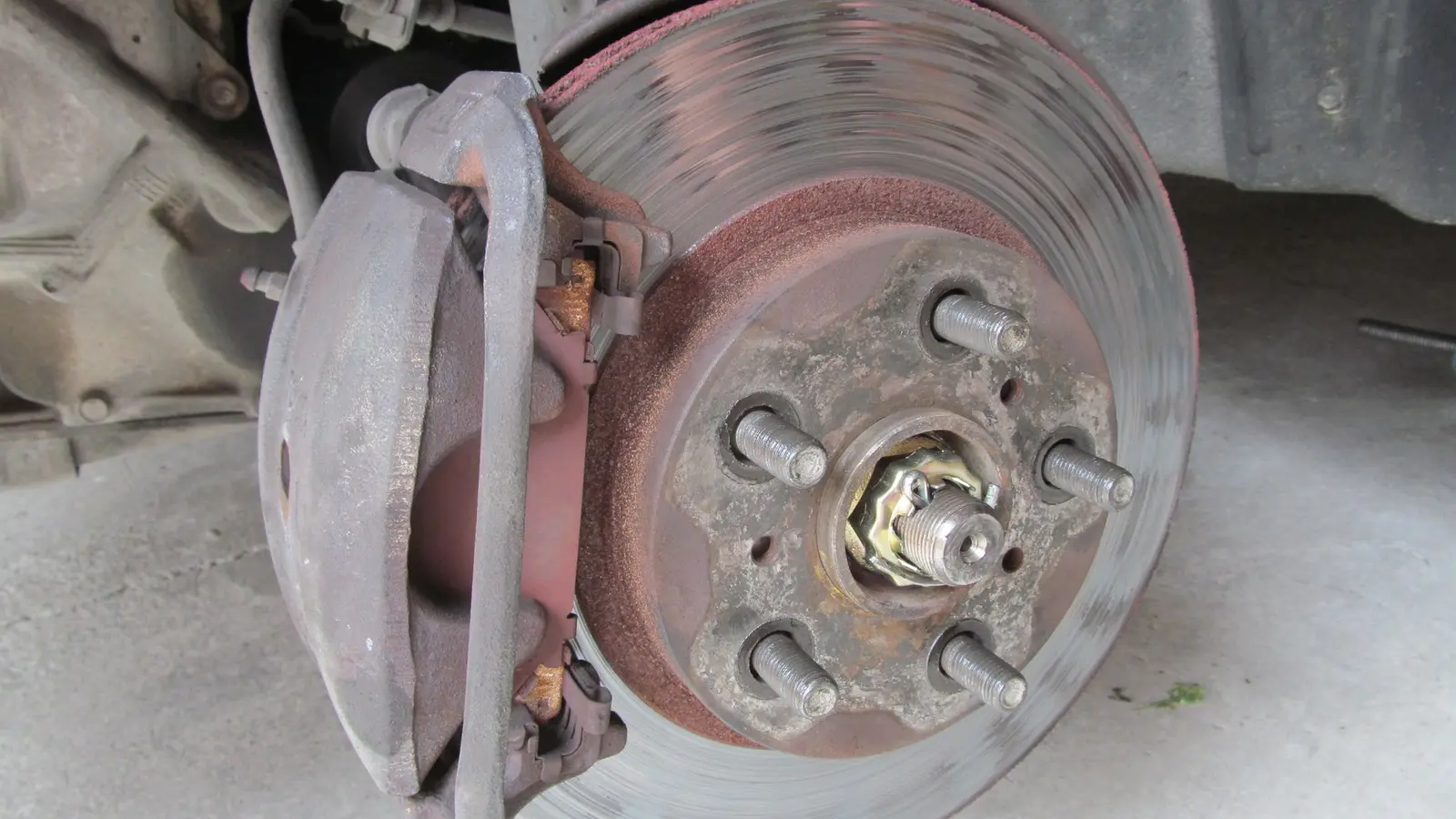
The brake disc also gradually gets thinner through friction. Each manufacturer specifies its minimum thickness. Brake manufacturer Brembo explains that this value is stamped directly on the disc with the abbreviation MIN TH (minimum thickness) and a number in millimetres. Thickness is measured with a caliper gauge at no fewer than four points on the friction surface, and the lowest measured value is what counts. If it is below the limit, the disc must be replaced, always in pairs on both wheels of the axle, even if only one has passed the limit. According to Brembo, discs are usually replaced at every second pad change. ADAC adds that on modern cars pads and discs are usually replaced together.
What to look for when inspecting the disc:
- A raised lip on the outer edge of the friction surface indicates that the disc is already noticeably worn.
- Deep grooves and an unevenly worn surface may mean uneven pad wear or a sticking caliper.
- Steering wheel vibration or a pulsating pedal when braking is often a sign of a warped or unevenly worn disc.
- Cracks on the friction surface are a reason to visit a workshop immediately.
Directive 2014/45/EU rates a worn disc as a major deficiency. An excessively worn, deeply scored, cracked or loose disc is a dangerous deficiency.
Brake fluid: why the boiling point matters
Common glycol ether-based brake fluids are hygroscopic, meaning they attract water. Moisture enters the system through hoses, seals and the reservoir vent. ADAC explains that as water accumulates, the fluid's boiling point drops, its viscosity increases and corrosion can form inside the braking system. During prolonged braking, for example on a downhill descent, the fluid heats up so much that the water in it starts to boil and vapour bubbles form. Unlike liquid, vapour can be compressed, so the pedal can sink to the floor and, in extreme cases, the brakes fail.
The fluid classes show how much harm water does. The DOT designation, which you will find on bottles in Europe too, comes from the American standard FMVSS 116. DOT 4 fluid, when new, must have a boiling point of at least 230 °C. Its so-called wet boiling point, measured after the reference fluid has absorbed about 3.7% water in the test, can be as low as 155 °C. For DOT 3 the limits are 205 and 140 °C. The manufacturer specifies in the owner's manual which class your car needs. Fluids should not be mixed, and ADAC advises against reusing an opened bottle that may already have absorbed moisture.
Because water accumulates with time rather than with kilometres, ADAC recommends changing the fluid at least every 2 years regardless of mileage. On some new cars the first change is only due after three years, but then also every two years. Do not judge the fluid's condition by its colour or a cheap test pen. Lubricant manufacturer Eurol found in its test that conductivity testers gave unreliable results and sometimes did not even detect added water. A device that measures the actual boiling point, as used by workshops, is more reliable.
You can at least check the level yourself. The reservoir under the bonnet has MIN and MAX marks, and the level should be between them. A slow drop in the level is usually natural as the pads wear. A sudden drop or wet traces near the wheels, however, may indicate a leak, and such a car must go to a workshop immediately. Directive 2014/45/EU rates a level below the MIN mark as a deficiency. If no fluid is visible in the reservoir at all, it is a dangerous deficiency.
After parking and on electric cars: rust and seizing
When a car stands outside for a few days, especially in damp conditions, a thin layer of rust appears on the discs. The first few brake applications usually wipe it off. ADAC states that noises often appear after a longer period of standing. If they do not go away after braking a few times, or you feel vibration in the steering wheel or pedal, a part may be worn. A disc brake that is used too little can rust so badly that it has to be replaced sooner.
This problem mainly affects electric cars and hybrids. Most of the deceleration is handled by regenerative braking, i.e. the motor generating electricity when braking, and the mechanical brakes are used less. ADAC therefore recommends braking harder now and then to clean the discs, of course only when the traffic situation safely allows it. Less friction also has an advantage: less brake dust. The European Euro 7 standard, applicable under Regulation (EU) 2024/1257 from 29 November 2026 for new passenger car types and from 29 November 2027 for all new cars, for the first time also limits particulate matter from brakes: to 7 mg/km for combustion cars and hybrids and to 3 mg/km for purely electric cars.
What you can do yourself and when to go to a workshop
Before winter, you can check several things without tools:
- The brake fluid level between the MIN and MAX marks and the date of the last change in the service book.
- Whether the brake or pad wear warning light is on in the instrument cluster.
- The condition of the outer pads and discs through the wheel rim: the thickness of the material, grooves and a raised lip.
- Behaviour during a test stop on an empty road: whether the car pulls to one side, whether the pedal feels soft and whether the steering wheel vibrates.
- Whether the handbrake holds the car on a slope.
ADAC does not recommend that non-professionals replace pads, discs or fluid themselves. Safety is at stake, and the work requires experience, precise tightening torques and, for the fluid, bleeding the system. The most practical approach is to combine the brake check with the switch to winter tyres, when the wheels are off. If you drive a diesel car, it is worth thinking about AdBlue during the same visit too, which we write about in the article AdBlue in a diesel: what every driver should know.
Brakes are also checked at the periodic roadworthiness test. Directive 2014/45/EU stipulates that passenger cars must undergo it no later than four years after first registration and then at least every two years. Member States may also require more frequent tests. A roadworthiness test, however, only captures the condition on one day. If you head for mountain roads in winter, a pre-season check is cheaper than a new set of discs or an accident.
Key takeaways
- According to ADAC, disc brake pads should be replaced when about 2 to 3 mm of friction material remains, and drum brake linings at around 1 mm.
- The minimum disc thickness is stamped on the disc with the abbreviation MIN TH; discs are always replaced in pairs across the whole axle.
- Brake fluid attracts water: when new, DOT 4 has a boiling point of at least 230 °C, but with water it can drop to 155 °C, which is why ADAC recommends changing it at least every 2 years.
- After the car has been parked and on electric cars with regenerative braking, discs rust more easily; ADAC recommends braking harder now and then when it is safe to do so.
- From 29 November 2026, Euro 7 limits brake dust for the first time for new car types: 7 mg/km, and 3 mg/km for electric cars.
FAQ
- How often should brake fluid be changed?
- ADAC recommends changing standard brake fluid at least every two years regardless of mileage, because it absorbs water over time. On some new cars the first change is after three years, then every two years. You will find the exact interval in the service book.
- At what thickness should brake pads be replaced?
- According to ADAC, disc brake pads should be replaced when about 2 to 3 mm of friction material remains, and drum brake linings at around 1 mm. If the car has a wear sensor and the warning light comes on, go to a workshop as soon as possible.
- Is rust on the discs after the car has been parked dangerous?
- A thin layer of rust after a few days parked in damp conditions is normal, and the first few brake applications usually wipe it off. If noises or vibration do not go away even after braking several times, have the brakes checked at a workshop. For electric cars, ADAC recommends braking harder now and then when it is safe to do so.
Comments
No comments yet. Be the first.
Add a comment
Your comment appears once the editors approve it. We never publish your email.
Do you sell cars?
A website for your dealership with a stock list that syncs itself from the listing portals. In 8 languages, ready in minutes.
30 days free, no card


