In this article
Why start preparing before the first frost
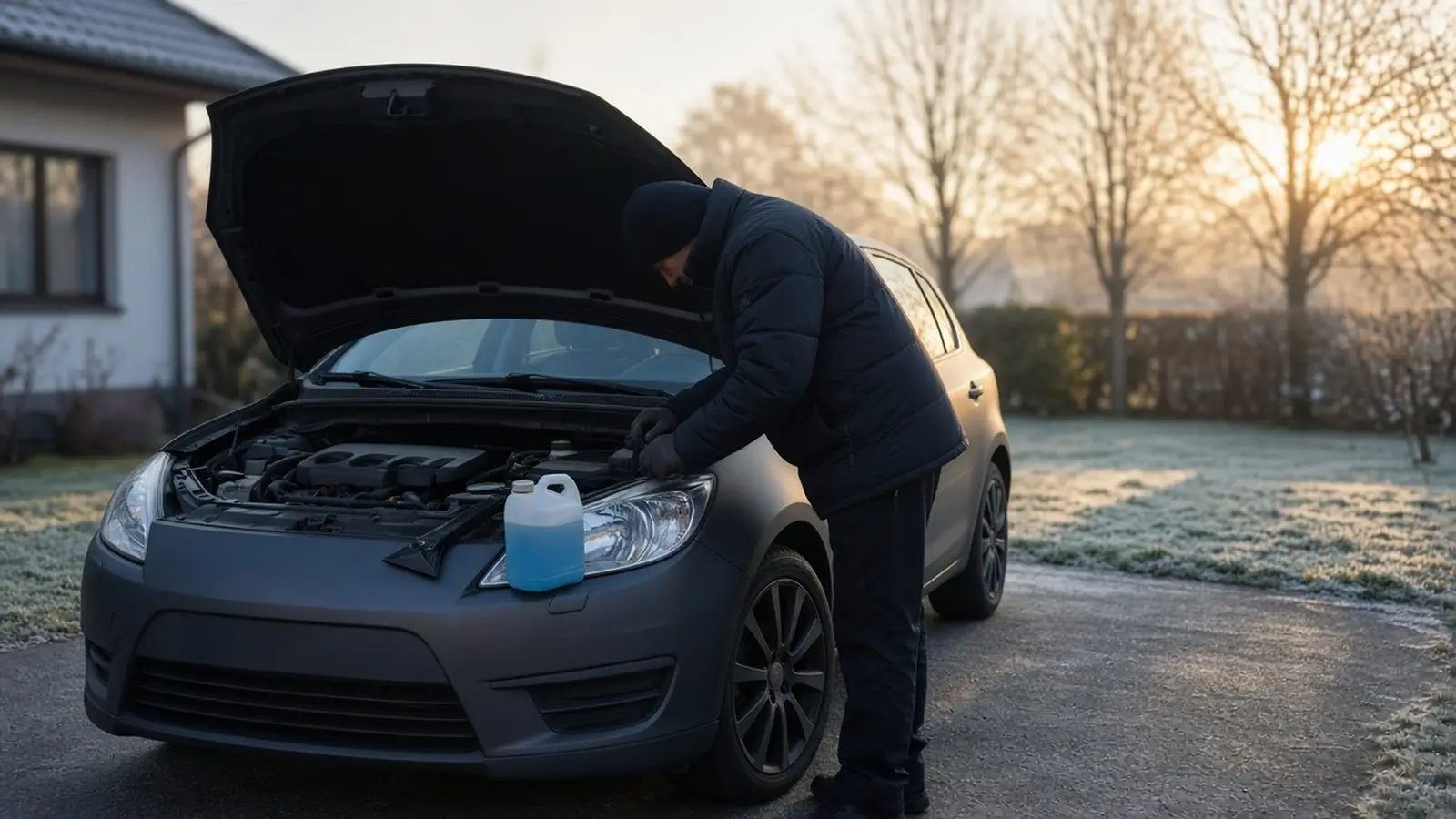
The first frosty morning is often a test your car may not pass. A battery that started the engine without trouble in September suddenly is not enough, the washer freezes and the wipers just smear dirt across the glass. Most of these problems can be prevented with a simple check you can do yourself in an afternoon, while it is still above zero and you can work comfortably in the garage or outside your home.
This checklist is written to apply to an ordinary passenger car anywhere in Europe. It does not replace a service inspection according to the manufacturer's schedule. It will, however, help you find out what you can do right away, what just needs topping up and what is better taken to a workshop. Before any work, check your car's owner's manual, because the location of reservoirs, the type of fluids and the recommended intervals differ between models.
Battery: the most common reason a car will not start in the morning
In winter, the starter battery is at a disadvantage. A cold engine with thicker oil needs more energy to start, while the battery can deliver less of it. Battery maker VARTA states that around 20 °C is optimal for a lead-acid battery. At 10 °C, the chemical activity in the battery drops to half, and at freezing point to only a quarter. According to VARTA, what damages a battery most is summer heat, which speeds up its ageing. A weakness that developed in summer therefore often only shows up in the first frosts.
What you can check yourself:
- Battery age. The production date is usually marked on the casing. If the battery is older and the car already starts more slowly, expect to replace it before it leaves you stranded.
- Terminals and clamps. A white or greenish coating and a loose clamp impair the flow of current. The clamps must sit firmly.
- How you drive. Short trips in town do not give the battery time to recharge, especially when heated seats, window heating and the fan are running at the same time. If you drive only a few kilometres a day, a charger connected overnight will help it through winter.
- A test at the garage. The real condition of the battery is shown by a load tester, which most workshops and parts shops have. A voltage reading from an ordinary multimeter without load does not tell the whole story.
Cars with start-stop systems have special EFB or AGM batteries. When replacing one, choose a battery of the same technology that the car manufacturer specifies. In many modern cars, a new battery also has to be registered in the control unit, which is a job for a workshop.
Coolant and washer fluid
Coolant protects the engine not only from overheating but also from freezing and corrosion. Check its level in the expansion tank with the engine cold, never hot, because the system is under pressure. The level should be between the MIN and MAX marks.
Concentration matters too. Coolant maker Glysantin recommends mixing concentrate with water at 50:50 and keeping the share of concentrate between 33 and 60%. According to the Glysantin G48 technical data sheet, a mix with 50% concentrate protects against freezing down to below −38 °C, while a mix with 33% protects only down to −18 °C. If you topped up with plain water over the summer, the protection may have dropped. A garage or an inexpensive refractometer will measure frost protection in a few seconds.
Glysantin also points out that coolant should be replaced roughly every three to four years, depending on the type of product and the car manufacturer's recommendation. Frost protection lasts a long time, but the additives that protect against corrosion break down over time. Do not mix different types of coolant. If you do not know which coolant is in the car, leave topping up to a garage.
Fill the washer reservoir with winter fluid before the first frost. Summer fluid or water in it will freeze, and the ice can damage the pump and the hoses. It is best to almost empty the reservoir first so that the winter fluid is not diluted by what is left of the summer one. Also check that the jets spray onto the right part of the glass. At a roadworthiness test under Directive 2014/45/EU, a washer that does not work or a misaimed jet is recorded as a defect.
Wipers, glass and lights
In winter you see the road less well, so everything that helps you see and be seen should work without fault. Replace wiper blades that leave streaks, squeak or miss strips. Look at the rubber up close too: a cracked or hardened edge does not wipe cleanly. In frost, never switch on the wipers on glass that is frozen over; you will damage the rubber and the motor.
Check the windscreen. A small stone chip can spread into a crack as frost and heating alternate. It is better to have minor damage repaired early, while it can still be repaired. Clean the glass on the inside, because fog is harder to clear from a greasy surface. Also check that the windscreen demister and the rear window heating work.
Walk around the car with the lights on and have someone press the brake and select reverse. Dipped and main beams, position lights, brake lights, reversing lights, fog lights and indicators must all work. Directive 2014/45/EU includes headlamp aim in the roadworthiness test in all member states. If oncoming drivers often flash at you or the lights shine unevenly, have them adjusted at a garage. You can find more about visibility in the dark in our article Driving in the dark after the clock change: lights and visibility.
Tyres, seals and winter kit
Tyres are the car's only contact with the road. Directive 89/459/EEC sets a minimum tread depth of 1.6 mm in the main grooves for passenger cars across the EU. For winter, however, that really is only the legal minimum, and on snow and slush it is far less than you would want. The rules on when and where winter tyres or snow chains are mandatory differ between countries, so check them before travelling abroad. We explain what the snowflake on a mountain symbol means and how to read the EU label in our article Winter tyres: what 3PMSF and the EU label mean. Check tyre pressure more often, because it drops as temperatures fall.
The rubber seals on doors and the boot can freeze in frost. Clean them and treat them with a rubber care product, for example a silicone-based one. A lock de-icer is useful for the locks and the fuel flap mechanism, but do not leave it in the car; keep it on you or at home.
Prepare a winter kit for the car:
- an ice scraper and a snow brush,
- gloves and a warm layer of clothing in case you have to wait,
- a torch and jump leads or a portable jump starter,
- a bag of grit or traction mats if you drive in the mountains,
- the mandatory equipment for the country you drive in, because the requirements are not uniform across the EU.
On longer winter trips, keep the tank fuller and, in an electric car, the state of charge higher than in summer. In a queue or on a closed road, a reserve for heating is very useful.
What to leave to a garage
Some jobs are not worth doing at home because they need tools, diagnostics or experience. These include the battery load test and battery replacement in cars that require battery registration, coolant replacement and bleeding the cooling system, checking the brakes including the brake fluid, headlamp adjustment and a chassis check. Pay particular attention to the brakes, because on a slippery road any fault shows up sooner.
If your regular service inspection is due soon, it makes sense to combine it with the winter check. Tell the mechanic what you have already checked yourself and what seemed wrong, for example slower starting, a noise when braking or fluid loss. You will save time and the workshop can focus on what matters.
The best time to get ready is now, while it is still relatively warm. Checking the battery, fluids, wipers and lights takes less than an hour and can save you a morning wait for a tow truck on the first frosty day.
Key takeaways
- According to VARTA, at 0 °C the chemical activity in a lead-acid battery drops to a quarter, which is why an older battery most often fails in the first frosts.
- According to the Glysantin G48 technical data sheet, a 50:50 coolant mix protects down to below −38 °C, while a mix with 33% concentrate protects only down to −18 °C.
- Fill the washer reservoir with winter fluid before the frost arrives and replace worn wiper blades.
- Under Directive 2014/45/EU, lights, wipers and washers are checked at roadworthiness tests across the EU.
- Leave the battery load test, coolant replacement, brakes and headlamp adjustment to a garage.
FAQ
- When is the best time to get a car ready for winter?
- Before the first frost, while it is still above zero outside. You can check the battery, fluids, wipers and lights yourself in under an hour, and working in milder weather is more comfortable.
- Can I top up the radiator with plain water?
- In an emergency, yes, but it dilutes the frost protection. Glysantin recommends a 50:50 mix of concentrate and water and a concentrate share between 33 and 60%. After topping up with water, have the frost protection measured.
- How can I tell whether the battery will last the winter?
- A load test at a garage or a parts shop shows it reliably. Warning signs are slower starting even in mild cold and an older battery.
Comments
No comments yet. Be the first.
Add a comment
Your comment appears once the editors approve it. We never publish your email.
Do you sell cars?
A website for your dealership with a stock list that syncs itself from the listing portals. In 8 languages, ready in minutes.
30 days free, no card


